
🔊Listen to a Deep Dive on Mindful Machines by clicking the above picture
Abstract
The rapid proliferation of large language models (LLMs) like GPT has catalyzed a transformation in artificial intelligence. These systems demonstrate linguistic fluency, scalability, and modularity, yet remain limited by their lack of memory, embodiment, intentionality, and meta-cognition. This paper introduces Mindful Machines—a novel class of AI systems designed not merely to simulate intelligence, but to participate in meaning-making. Grounded in the General Theory of Information (GTI), 4E cognition, and digital genome encoding, Mindful Machines aim to overcome the epistemic, architectural, and ethical limitations of current generative and agentic paradigms. We compare existing approaches, explore the architectural components of Mindful Machines, and articulate a vision for intelligence that is structurally adaptive, ethically coherent, and teleonomically guided.
1. Introduction: The Limits of Generative AI
LLMs excel at producing text, completing prompts, and aligning multimodal inputs—but these capabilities mask structural deficiencies:
- No persistence of memory: LLMs operate within short context windows, lacking continuity across interactions.
- No grounded intentionality: They follow prompts but have no goals of their own.
- No meta-cognition: They cannot reflect on their output or improve themselves autonomously.
- No embodiment: They are not situated in any environment or system of consequences.
These limitations render LLMs competent without consciousness, powerful yet shallow simulators of intelligence.
2. Reframing Intelligence: From Tokens to Teleonomy
Mindful Machines represent a fundamental rethinking of intelligence. They are not just tools but synthetic selves—systems that perceive, remember, plan, and evolve.
Key principles include:
- Teleonomy: Purpose emerges from internal structure and self-regulating logic—not from human-imposed tasks.
- Structural coupling: Like biological organisms, these systems adapt their form and function in tandem with environmental feedback.
- Narrative coherence: Truth is contextual, grounded in memory and identity—not raw data correlation.
This shift moves AI from task-based automation to epistemic orchestration—where systems do not just generate content, but construct and refine meaning over time.
3. The Architecture of Mindful Machines

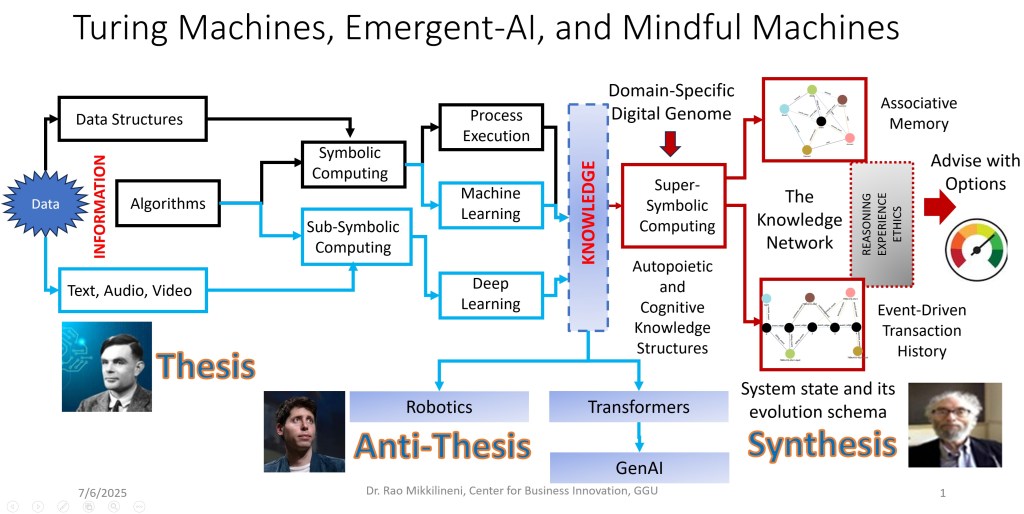
Mindful Machines Architecture
A. Digital Genome
At the core is a digital genome: a formal specification encoding the system’s modular design, interaction rules, memory architecture, and evolutionary capabilities. It plays four major roles:
- Structure: Defines forms, functions, and dependencies.
- Memory schema: Stores knowledge across semantic, episodic, and causal layers.
- Adaptation logic: Guides repair, replication, and recomposition.
- Goal orchestration: Enables teleonomic behavior by aligning submodules with emergent goals.
B. 4E Cognition
Mindful Machines implement 4E cognition:
- Embodied: They are grounded in sensory-like data streams (e.g., video, audio, logs) and act within environments.
- Embedded: Their cognition is shaped by contextual variables and relational states.
- Enactive: They learn meaning through action and feedback.
- Extended: Their cognition spans internal modules (e.g., memory, planners) and external tools (e.g., APIs, databases).
LLMs serve as useful cortical modules—interpreting text, summarizing state, or generating hypotheses—but they are orchestrated by a larger adaptive system.
C. Cognizing Oracles
These are meta-cognitive agents that:
- Evaluate internal states and memories.
- Reframe interpretations based on shifting context.
- Track narrative coherence and ethical consistency.
- Guide self-repair and self-improvement.
They replace the brittle logic of agentic systems with reflective adaptation grounded in context.
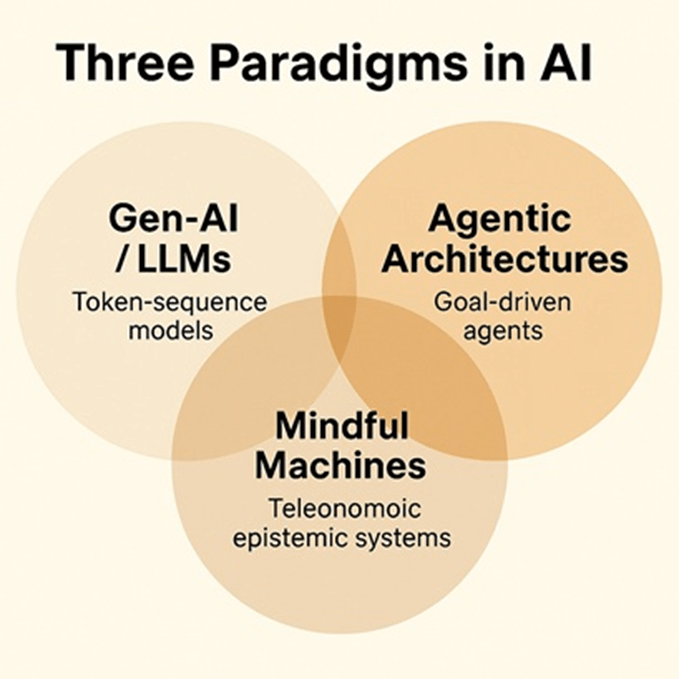
4. Comparative Overview
| Dimension | LLMs (Gen-AI) | Agentic AI | Mindful Machines |
| Architecture | Token sequence prediction | Goal-driven planning | Genome-encoded modular systems |
| Memory | Stateless context windows | Task-state tracking | Semantic, episodic, and causal memory |
| Intentionality | Prompt-aligned | Externally defined goals | Teleonomic (structure-driven goals) |
| Meta-Cognition | Simulated via prompts | None or limited task-level logic | Reflexive self-models and oracles |
| Ethics & Ontology | Symbolic but shallow | Constraint-based heuristics | Causal-symbolic reasoning with feedback |
| Resilience | Fragile, needs retraining | Fails with recursion | Self-adaptive, narrative-stable |
| Scalability | Horizontal (replication) | Multi-agent coordination | Holarchic, structurally coherent growth |
| Cognition | Surface fluency | Tactical control | 4E-based, improvisational, contextual |
| Embodiment | Disembodied | Limited interface use | Fully situated, interface-aware |
5. Implementing 4E Cognition with LLMs and Sensor Integration
LLMs can play an essential role in mindful architectures when embedded within a multimodal, memory-rich, event-driven system:
- Text, audio, video inputs are transformed into structured representations using LLMs as perceptual interpreters.
- These representations are linked to causal and episodic memory scaffolds, allowing the system to track “what happened,” “why it mattered,” and “how it shaped future decisions.”
- Cognizing oracles evaluate this evolving memory to refine behavior and learning strategies.
- The system becomes interactive, self-reflective, and goal-modifying—capabilities far beyond what LLMs can do alone.
This is how cognitive modularity, intentional behavior, and narrative learning are achieved—not with more parameters, but with structural coherence and reflexive design.
6. Enterprise Implications: From Automation to Epistemic Collaboration
Gen-AI offers:
- Cheap, scalable summaries.
- Natural language interfaces.
- Prompt-tuned solutions.
Agentic AI offers:
- Rule-based process automation.
- Modular execution pipelines.
- Task resilience within narrow bounds.
Mindful Machines offer:
- Adaptive co-evolution with enterprise goals.
- Causal reasoning with narrative grounding.
- Human-aligned decision-making and ethical continuity.
Example: In healthcare, a genome-guided assistant evolves with a patient’s narrative history, delivering proactive care insights—not just reactive diagnosis. It collaborates, reasons, and adjusts, much like a human caregiver.
7. From Critique to Constructive Transformation
Skeptics rightly question AI systems’ depth, ethics, and safety. Mindful Machines directly address these concerns:
- Not black boxes: they feature transparent, modular structure.
- Not reactive tools: they enact persistent, modifiable goals.
- Not static models: they evolve through experience and feedback.
- Not ethically naïve: they embed meaning, coherence, and pluralistic logic in decision frameworks.
They do not reject current technologies. Instead, they repurpose them within a more rigorous and biologically inspired framework.
8. Conclusion: Toward Participatory Intelligence
In the age of Gen-AI, the dominant question is: “What can AI generate?”
In the age of Mindful Machines, the question becomes:
“What can AI understand, remember, and responsibly decide?”
By combining structural memory, reflexive models, digital genomes, and 4E cognition, Mindful Machines chart a path beyond prompt-based mimicry. They promise not just smarter software, but synthetic entities that participate in meaning-making, co-evolve with human systems, and guide the next phase of technological intelligence.
The challenge ahead is not just technical—it is epistemological, ethical, and architectural.


 Theoretical and Foundational Problems (TFP) in Information Studies