Machine Intelligence, Biological Intelligence, The True Nature of Energy, Matter, Information, Knowledge, and all that Jazz

The information carried by this video is “my” understanding of the General Theory of Information. The receiver of this information converts it into receiver’s knowledge network and the interpretation very much depends on the wired and learned knowledge structures carried within the mental world of the receiver. Each interpretation is unique depending on the receiver’s knowledge structures (both wired and learned).

Introduction

These are personal notes in my attempt to understand what the General Theory of Information tells us about how we make sense of our behaviors and how we relate to each other including ourselves (self-reflection), the material universe we encounter, and the intelligent machinery we build. It is work in progress going through the discovery, reflection, application, and sharing process. As I write these notes to share, I am discovering new areas that I need to explore and will repeat the learning process.

The Thesis, Antithesis, and the Synthesis

Jazz allows the interplay of structure and freedom through three dialectical stages of development: a thesis, giving rise to its reaction; an antithesis, which contradicts or negates the thesis; and finally, the tension between the two being resolved using a synthesis. We can say that our understanding of artificial intelligence (AI) we implement using digital computers, and natural intelligence (exhibited by living beings) is going through the same stages of development.

The thesis began with the building of a digital computer. Alan Turing, in addition to giving us the Turing Machine from his observation of how humans used numbers and operations on them, also discussed unorganized A-type machines. His 1948 paper “Intelligent Machinery” gives an early description of the artificial neural networks used to simulate neurons today. His paper was not published until 1968 – years after his death – in part because his supervisor at the National Physical Laboratory, Charles Galton Darwin, described it as a “schoolboy essay.”

While in 1943 McCulloch and Pitts[1], proposed mimicking the functionality of a biological neuron, Turing’s 1948 paper discusses the teaching of machines as this summary says from his 1948 paper. “The possible ways in which machinery might be made to show intelligent behavior are discussed. The analogy with human brain is used as a guiding principle. It is pointed out that the potentialities of the human intelligence can only be realized if suitable education is provided. The investigation mainly centres round an analogous technique teaching process applied to machines. The idea of an unorganized machine is defined, and it is suggested that the infant human cortex is of this nature. Simple examples of such machines are given, and their education by means of rewards and punishment is discussed. In one case, the education process is carried through until the organization is similar to that of an ACE”

Here ACE refers to the Automatic Computing Machine which was a British early electronic serial stored program computer designed by him. Current-generation digital computers are stored program computers that use sequences of symbols to represent data containing information about a system and programs that operate on the information to create knowledge of how the state of the system changes when certain events represented in the program change the behavior of various components or entities that are interacting with each other in the system. The machines thus are taught about human knowledge of how various systems they observe behave in the digital notation using sequences of symbols.

It is interesting to see his vision of the thinking machine. “One way of setting about our task of building a ‘thinking machine’ would be to take a man as a whole and try to replace all the parts of him by machinery. He would include television cameras microphones, loudspeakers, wheels and ‘handling servomechanisms’ as well as some sort of ‘electronic brain’. This would of course be a tremendous undertaking. The object if produced by present techniques would be of immense size, even if the ‘brain’ part were stationary and controlled the body from a distance. In order that the machine would have a chance of finding things out for itself it should be allowed to roam the countryside, and the danger to the ordinary citizen would be serious. However even when the facilities mentioned above were provided, the creature would still have no contact with food, sex, sport and many other things of interest to the human being. Thus although this method is probably the ‘sure’ way of producing a thinking machine it seems to be altogether too slow and impracticable.”

Perhaps this paragraph prompted the remark about a schoolboy’s essay by his superior and withholding publication delaying it till 1964. I wonder what the impact would have been, if this paper was published and available in 1953 to the Dartmouth Summer Project organized by Shannon, Minsky, Rochester, and McCarthy

It is remarkable that Turing predicted what areas are suitable and had an opinion about what would be most impressive.

“What can be done with a ‘brain’ which is more or less without a body providing, at most, organs of sight, speech, and hearing. We are then faced with the problem of finding suitable branches of thought for the machine to exercise its powers its powers in. The following fields appear to me to have advantages:

(i) Various games, e.g., chess, noughts and crosses, bridge, poker

(ii) The learning of languages

(iii) Translation of languages

(iv) Cryptography

(v) Mathematics

…. Of the above possible fields, the learning of languages would be the most impressive, since it is the most human of these activities.”.

The thesis is that teaching machines how to perform tasks using programs and data (represented as sequences of symbols) and using neural network models to convert information received from various sources into knowledge have delivered a class of intelligent machinery that has proved to be very valuable in improving processes to enable communication, collaboration conducting commerce at scale with efficiency. Obviously, we have made tremendous progress in all the five areas mentioned by Turing.

In addition, we have also made progress in making machines that roam the countryside in the form of autonomous vehicles, robots and drones without posing danger to ordinary citizen unless it is intended by the users of these intelligent machinery.

The antithesis is that the progress also brings unwanted or undesired side effects in the form of using AI to impact ordinary citizen’s freedom, privacy, safety, and survival. While some of the issues are the makings of human greed, propensity of few to control the lives of many, and the good old conflict between the good and the evil, the technological progress with both the general-purpose computers, and AI machines have accelerated the pace for both the good and the evil and increased the gap between the haves and the have-nots. The unbridled power wielded by the state in collusion with big-tech is wreaking havoc on free-speech and threatening democracies with selective abuse of technology. Fake news, fraud, invasion of individual privacy and security are accelerated and committed at a scale that was not possible before the Internet and AI.

The shortcomings of current generation half-brained AI and the limits of symbolic computing based cognitive structures are well documented.

Information | Free Full-Text | A New Class of Autopoietic and Cognitive Machines (mdpi.com)

BDCC | Special Issue : Data, Structure, and Information in Artificial Intelligence (mdpi.com)https://tfpis.com/wp-content/uploads/2022/07/iiai-aai-paper-general-theory-of-information.pdf)

In addition, as John von Neumann[2] pointed out in 1948, “It is very likely that on the basis of philosophy that every er-ror has to be caught, explained, and corrected, a system of the complexity of the living organism would not last for a millisecond. Such a system is so integrated that it can operate across errors. An error in it does not in general indicate a degenerate tendency. The system is sufficiently flexible and well organized that as soon as an error shows up in any part of it, the system automatically senses whether this error matters or not. If it doesn’t matter, the system continues to operate without paying any attention to it. If the error seems to the system to be important, the system blocks that region out, by-passes it, and proceeds along other channels. The system then analyzes the region separately at leisure and corrects what goes on there, and if correction is impossible the system just blocks the region off and by-passes it forever. The duration of operability of the automation is determined by the time it takes until so many incurable errors have occurred, so many alterations and permanent by-passes have been made, that finally the operability is really impaired. This is completely different philosophy from the philosophy which proclaims that the end of the world is at hand as soon as the first error has occurred.”

This “self-regulation” behavior exhibited by biological systems are made possible by cell replication, and metabolism using energy and matter transformations. The knowledge to replicate cells, use them to build cognitive apparatuses, sense and process information using several mechanisms, and use the knowledge to execute life processes is encoded in the genome.

According to Wikipedia “The human genome is a complete set of nucleic acid sequences for humans, encoded as DNA within the 23 chromosome pairs in cell nuclei and in a small DNA molecule found within individual mitochondria. These are usually treated separately as the nuclear genome and the mitochondrial genome.[4] Human genomes include both protein-coding DNA sequences and various types of DNA that does not encode proteins. The latter is a diverse category that includes DNA coding for non-translated RNA, such as that for ribosomal RNAtransfer RNAribozymessmall nuclear RNAs, and several types of regulatory RNAs. It also includes promoters and their associated gene-regulatory elements, DNA playing structural and replicatory roles, such as scaffolding regionstelomerescentromeres, and origins of replication, plus large numbers of transposable elements, inserted viral DNA, non-functional pseudogenes and simple, highly-repetitive sequences. Introns make up a large percentage of non-coding DNA. Some of this non-coding DNA is non-functional junk DNA, such as pseudogenes, but there is no firm consensus on the total amount of junk DNA.

“Human body is a building made from trillions of building blocks called cells. Cells exchange nutrients and chemical signals. Each cell is akin to a tiny factory, with different types of cells performing specialized functions, all of which contribute to the working of the entire body.”

For a more detailed discussion of the society of genes and how they organize themselves to build the autopoietic and cognitive system, see the book “The Society of Genes”

[Yanai, Itai; Martin, Lercher. The Society of Genes (p. 11). Harvard University Press. Kindle Edition.’]

The cognitive processes both wired in the genome and learned using the cognitive apparatuses the biological system provide a unique sense of the self and are pivotal for the intelligent behavior that allows the system to manage itself and its interactions with the external universe.

As Damasio [3] points out “Humans have distinguished themselves from all other beings by creating a spectacular collection of objects, practices, and ideas, collectively known as cultures. The collection includes the arts, philosophical inquiry, moral systems and religious beliefs, justice, governance, economic institutions, and technology and science. Why and how did this process begin? A frequent answer to this question invokes an important faculty of the human mind—verbal language—along with distinctive features such as intense sociality and superior intellect. For those who are biologically inclined the answer also includes natural selection operating at the level of genes. I have no doubt that intellect, sociality, and language have played key roles in the process, and it goes without saying that the organisms capable of cultural invention, along with the specific faculties used in the invention, are present in humans by the grace of natural selection and genetic transmission. The idea is that something else was required to jump-start the saga of human cultures. That something else was a motive. I am referring specifically to feelings, from pain and suffering to well-being and pleasure. …”

This leads us to the question – What are the limitations of intelligent humans and today’s intelligent machines? How can we compensate for the frailties of humanity and improve the intelligence of machines to assist human intelligence in building a better societal consciousness and culture. A synthesis can only occur if we develop a deeper understanding of how human intelligence has evolved through natural selection, how it is passed on from the survivors to successors, and how biological intelligence processes information received through their cognitive apparatuses and uses the knowledge to execute behaviors that are considered intelligent and assist in securing their stability, safety, and survival while the systems pursue the goals defined in their wired and learned life processes.

Back to the Basics

Philosophers from the East and the West have been pondering the true nature of the Material and Mental Worlds and their relationships. Between the 8th and 6th B.C.E., Samkhya philosophy advocated two realities, Prakriti, matter, and Purusha, self. In China, Confucius (551 – 479 B.C.E.) focused on knowledge consisting of two types: one was innate, while the other one was from learning. In ancient Greece, Heraclitus (500 B.C.E) acknowledged the existence of the material world but emphasized that it is constantly changing.

Plato (427-347 B.C.E.) admitted the existence of an external world but came to the conclusion that the world perceived by the senses is changing and unreliable. He maintained that the true world is the world of ideas, which are not corruptible. This world of ideas is not accessible to the senses, but only to the mind. He proposed Ideas/Forms as a more general system of abstractions. Aristotle, Plato’s student on the other hand, not only affirmed the existence of the real world but also maintained that our ideas of the world are obtained by abstracting common properties of the material objects the senses perceive. Coming to the more recent philosopher, Rene Descartes (1596-1650) believed that the external world was real, and objective reality is indirectly derived using the senses. He classified his observations of the material objects into two classes, primary and secondary.  Motion is classified as primary, and the color is secondary. Hobbs (1650) proposed that ideas are images or memories received through the senses. He did not believe in ideas and postulated that we reason using symbols and names for experiences.

These concepts are well reviewed by Prof. Burgin in his book “Theory of Knowledge“, and his articulation of the general theory of information (GTI), and the theory of structural reality brings together with a scientific interpretation many of the observations of these philosophers and provides a theory that integrates our understanding of the material and mental worlds using the world of ideal structures as the underlying foundation. According to GTI, the existential triad consists of:

  1. The material world deals with energy, matter, and their interactions resulting in the formation of material structures in space and their evolution in time. The material world is governed by the laws of nature (which we observe and model using the mental structures of physics and mathematics).
  2. The mental world perceives the state of material structures in space, and their evolution in time in the form of information, and is stored as knowledge in the form of mental structures.  The mental structures use the ideal structures in the form of fundamental triads (namespaces) that assign labels for the entities, and use the knowledge about their relationships and evolutionary behaviors.
  3. The world of ideal structures provides a representation of material and mental structures in the form of labels of observed physical or mental entities, their attributes, relationships, and their behavioral evolution in time. The fundamental trial, therefore, allows the representation of material and mental structures in space and time.

In short, material structures are formed and evolve based on energy and matter transformations. The ideal structures provide a mechanism not only to represent the material structures. An observer can use the observations received as information and create mental structures not only to represent the observations but also use other structures to reason and use physical structures to interact with the material world.

Structures in the form of the fundamental triads provide the means to create knowledge from information and use it to reason and interact with material structures.

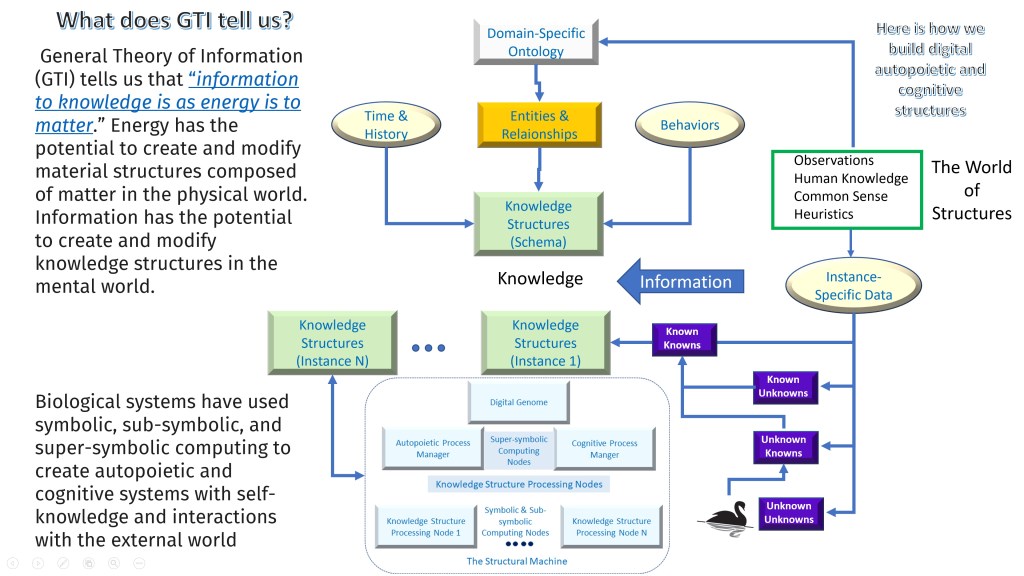
In essence, information is to knowledge as Energy is to matter.  Energy has the potential to create or modify material structures.  Material Structures carry information that observers can receive using various senses and create knowledge in the form of mental structures.  The mental structures allow the observer to model and reason about the observations using ideal structures (which include various entities, their relationships and their dynamic behaviors) and interact with the material world. The observations include the state of the material structures and their dynamics as they change based on the interactions within and with the external world.

Information carried by the material structures is the bridge between the material and the mental worlds.  Information, therefore, takes the material or mental forms and provides descriptions of the structures in the form of their state and evolutionary behaviors in time.

The mental structures provide the means to create the processes of creating representations of observations, abstractions reasoning, and inferencing such s deduction, induction, and abduction.  Mathematics is created as mental structures that are composed of fundamental triads consisting of symbols and names or labels.

How is this related to understanding intelligence both natural and artificial? GTI provides tools to model the autopoietic and cognitive behaviors of biological systems and also to infuse autopoietic and cognitive behaviors into digital automata. In addition, it provides a deep understanding of information and knowledge and how they are related to energy and matter. Understanding the difference between ontological information contained in the material universe and the epistemological information perceived by the biological systems as observers (which depends on the cognitive apparatuses that the observer brings to receive and process information) is necessary to understand how the observers interact with the universe and with each other. Language is one carrier of information that is invented to facilitate communication between the observers acting as senders and receivers.

What is Language?

While volumes have been written about language in many languages and many experts are using AI to automate language processing to extract knowledge using machines to gain insights with the hope to match human ability, it is equally important to reexamine what the role of language is, given the new understanding of information and information carriers from GTI.

According to GTI, language whether spoken or written is a well-structured mental carrier of information that describes the state and dynamics of various material or mental structures in the form of fundamental triads. A fundamental triad as we have seen in the above discussion is an ideal structure describing its state and evolution in terms of various entities, their relationships, and the behaviors that evolve the state when various events cause fluctuations. Fundamental triads are composable structures describing the information of a system’s state and its evolution. Language is purely a mental structure conceived by biological systems using their neural networks which receive and process information into knowledge also in the form of structures. Information is materialized by the physical structures of biological systems in various forms as carriers of information and communicated as sequences of sounds or sequences of symbols. Each individual’s mental structures are trained (over a life-time using various means) to create, communicate and process information into executable knowledge in the form of mental structures. If we accept this thesis, it opens up a new way to process language using machines. Language represents materialized information composed of fundamental triads representing a specific domain or system which contains various labeled entities, their relationships, and the evolution of the system where various interactions change the structures. The ontology of the domain provides a model of the labeled entities and the relationships. GTI provides a schema and defines operations on them to model the knowledge structures. Combining the ontologies and the operations we can create a schema that represents the knowledge structures the language carries as structures of the domain. Natural language processing algorithms can then read the specific text to populate the schema with various instances.

What are, Sentience, Consciousness, Self-Awareness, and Sapience?

According to GTI, sentience, consciousness, self-awareness, and sapience (wisdom or insight) are the outcomes of cognitive behaviors exhibited by the biological structures in the form of a body made up of material structures and a brain or a nervous system made up of neurons. They are the result of the states of a “self”, interactions with the external world, and the history of its state evolution. The “self” appears at various levels of organization of the system composed of autonomous process execution nodes communicating with each other. These outcomes are unique to each individual living being. They can express themselves using information carriers like language or gestures etc. Information is the description of a mental or physical structure described in terms of the fundamental triads. Information is materialized or mentalized by the physical structures and communicated using the information carriers.

Using the tools of GTI, the cognitive behaviors can be modeled as a multi-layer knowledge network where the functional nodes are grouped to execute the cognitive behaviors in the form of local functional nodes, clusters of functional nodes, and a global knowledge network. Information received through the senses is processed by neural networks and nodes that are fired together wire together to capture the state and evolution of the structures the information describes. The functional nodes that are wired together fire together to exhibit cognitive behaviors.

The knowledge structures act as functional nodes, clusters of the knowledge structures, and global knowledge networks store the various states of the mind, brain, and body system and their evolution using the life processes specified in the genome.

According to Sean Caroll , there are two factors that define the form and function of the new cellular organism that contains the genetic description. “The development of form depends on the turning on and off of genes at different times and places in the course of development. Differences in form arise from evolutionary changes in where and when genes are used, especially those genes that affect the number, shape, or size of structure.” In addition a class of genetic switches regulates how the genes are used and play a great role in defining the function of the living organism.

[S. B. Caroll, “The New Science of Evo Devo—Endless Forms Most Beautiful,” W. W. Norton & Co., New York, 2005.]

The evolution of the state is non-Markovian and depends not only on the events that are influencing the evolution at any particular instant but also on the history that is relevant to the cognitive behavior. This is in contrast to current symbolic computation using digital computers which is Markovian. A Markov process assumes that the next state of a process only depends on the present state and not the past states.

The knowledge network involved in cognitive behaviors is unique to each individual and state history is managed by the life processes derived from the genome.

How are Sentient Structures Different from Material Structures?

Material structures are formed through energy and matter interactions obeying the laws of physics. Their structures composed of constituent components are subject to fluctuations caused by external forces and their evolution is determined by the laws of physics and thermodynamics. For example, the changes in the structure with a collection of iron filings are affected by an external magnetic force applied.  When the fluctuations cause large changes in its components within the structure, it goes through phase transitions that minimize the entropy of the structure.

The behavior of material structures interacting with external forces obeys the laws of physics dealing with the transformation of matter and energy. However, when various structures come together, their components undergo changes based on the interactions of these structures also under the influence of the laws of physics. These interactions cause fluctuations in individual state evolution and if the interactions are strong and fluctuations are large, the individual structures experience a non-equilibrium condition where the entropy and the energy of the whole system change. The system (called the complex adaptive system, CAS) consists of autonomous individual structures undergoing structural changes and adapting to their environment consisting of other structures. For example, when the element Phosphorus comes close to oxidants, halogens, some metals, nitrites, sulfur, and many other compounds, it reacts violently causing an explosion hazard. Other systems when fluctuations drive the system to far from equilibrium states, undergo emergence that could change their state. The outcome is not self-managed but is an emergent outcome based on state transitions from one energy minimum to another.

CAS exhibits self-organization through emergence, non-linearity, the transition between states of order and chaos. The system often exhibits behavior that is difficult to explain through an analysis of the system’s constituent parts. Such behavior is called emergent. CAS are complex systems that can adapt to their environment through an evolution-like process and are isomorphic to networks (nodes executing specific functions based on local knowledge and communicating information using links connecting the edges). The system evolves into a complex multi-layer network, and the functions of the nodes and the composed structure define the global behavior of the system as a whole. Sentience, resilience, and intelligence are the result of these structural transformations and dynamics exhibiting autopoietic and cognitive behaviors. Autopoiesis here refers to the behavior of a system that replicates itself and maintains identity and stability while facing fluctuations caused by external influences. Cognitive behaviors model the system’s state, sense internal and external changes, analyze, predict and take action to mitigate any risk to its functional fulfillment.

However, when the structure experiences large fluctuation in the interactions, the non-equilibrium dynamics drive the state into a new structure based on the emergent behavior which is non-deterministic.  The outcome may or may not be the best for the structure’s stability and sustenance. When a large number of structures start interacting together, the laws of thermodynamics influence the microscopic and macroscopic behaviors of these structures. According to the first law of thermodynamics, if the energy of the system consisting of structures that are interacting with each other is conserved, it would reach equilibrium and the structures would tend to be stable. The second law of thermodynamics states that if a closed system is left to itself, it tends to increase disorder and entropy, which is a measure of the disorder. However, if the system can exchange energy with the environment outside, it can increase its order by decreasing entropy inside and transferring it to the outside. This allows the structures to use energy from outside and form more complex structures with lower entropy or higher order. It seems that living organisms have evolved from the soup of physical and chemical structures in three different phases, where the characteristics of the evolving systems are different. In all phases, evolution involves complex multi-layer networks. According to Westerhoff et al., “Biological networks constitute a type of information and communication technology (ICT): they receive information from the outside and inside of cells, integrate and interpret this information, and then activate a response. Biological networks enable molecules within cells, and even cells themselves, to communicate with each other and their environment. (https://www.frontiersin.org/articles/10.3389/fmicb.2014.00379/full )

Conclusion

It is illuminating to learn about the worlds I, as an individual, live in. The material world and the mental worlds I live in deal with matter, energy, knowledge, and information. The digital world is an extension of the material world, to which the meaning is given by the mental world. It assigns meaning to what the physical structures such as computers networks, storage etc. produce. The information contained in the digital world enhances the mental world creating the virtual world. With this picture we will start to understand various entities we interact with and their relationships and their evolution. Hopefully, this knowledge helps us to understand the contemporary human societies we live in and allows us to improve our behaviors to enjoy the finite time we have in the material world. It is interesting to realize that each one of us is a unique entity born at t=0, but our footprints continue to exist till eternity, in a multitude of information carriers even as we cease to be a living system when we succumb to the inevitable death.

Food for thought.

Acknowledgement

Many people I have interacted with, have contributed to my interpretation of the material, mental and digital worlds I live in. Of particular note, special persons who deepened my knowledge are shown here.”


[3] Damasio, Antonio R. The Strange Order of Things (pp. 3-4). Knopf Doubleday Publishing Group. Kindle Edition.


[2] W. Aspray and A. Burks, “Papers of John von Neumannon Computing and Computer Theory,” MIT Press, Cam- bridge, 1989


[1] “Because of the “all-or-none” character of nervous activity, neural events and the relations among them can be treated by means of propositional logic.” The 1943 paper of McCulloch and Pitts lays the foundation for deep learning where neurons fired together are wired together to represent knowledge from the epistemic information received from observations in biological systems.

Structures, The Existential Triad, Physics, Metaphysics, Information, Knowledge, General Theory of Information, True Nature of Intelligence, and all that Jazz

Figure 1: The existential triad consists of the world of ideal structures, the physical world, and the mental world.

Introduction

Despite many books, articles, and various attempts to define them, the words “information” and “knowledge” remain confusing. Statements in peer-reviewed articles often contradict each other. For example, sensational statements like these “Your brain does not process information, retrieve knowledge or store memories” are made with certain assumptions about what information is. For this author, information is what is represented by symbols in a computer and is manipulated by algorithms. While digital computers provide information processing structures that allow us to model the physical world that we perceive and interact with it using digital machines. However, information is more than symbols and the information processing and its use very much depend on the receiver. For example, the same symbol can mean different things to different receivers. Some symbols may not mean anything to some observers.  A Chinese Kanji symbol does not mean anything to the person who does not know what Kanji symbols are. Similarly, two different sequences of symbols can give the same information to the receiver. This brings us to the conclusion that how information is perceived and processed depends very much on what mechanisms the receiver uses to process information and how it is related to the knowledge the receiver already possesses. In essence, information has the potential to change the knowledge the receiver already possesses.

There are various forms of information processing apparatuses. For example, digital computers use the stored-program implementation of the Turing machine which was conceived by Alan Turing watching, how humans compute using numbers, which are symbols. However, as humans, we do more than just compute numbers. Living organisms have developed through the processes of evolution and natural selection, a different kind of information processing apparatuses specified in the genome in the form of structures made up of genes and neurons. The genes encode knowledge to use matter and energy transformation processes to build physical structures that process information and convert it into knowledge which enables them to create their own mental structures. To understand the true nature of “information”, we have to look at various entities that are involved such as physical structures which carry information, physical structures that enable information access, processing, and communication to create knowledge and use it to potentially change their own structures and the structures they interact with.

From the cookie monster’s definition (information is about something, new, and true) (see this interesting video on “what is information”) to the current articulation of the relationship between information and knowledge, there have been many attempts to define it. Finally, the general theory of information (GTI) developed by Prof. Mark Burgin provides a mathematical theory that relates it to the physical and mental structures, the information they carry and provides a framework for understanding its communication, and processing to derive knowledge. The gist of the general information theory is that information to knowledge is as energy is to matter. Matter and energy transformations occur and knowledge structures are created by the observer observing the material world. Before we proceed to understand the full ramifications of GTI, it is important to clarify various labels such as information, structure, and knowledge.

Information, Knowledge, Structures, The Role of the Observer and the Observed

Matter and energy are the essence of the material world which consists of physical structures that are formed through transformations of energy and matter.  Matter consists of various entities that interact with each other and energy has the potential to change the system composed of matter. From an observer point of view, physical sciences describe how energy and matter interact and how the material world operates with various constraints dictated by the laws of transformation of matter and energy. The material world exists whether it is observed or not.  This is true both in the quantum and non-quantum physical worlds. The role of the observer has an impact on the material world. First, the observer affects the quantum state through observation. Second, the observer identifies the various states of the physical world through various sensory perceptions and discerns the information received through these observations into knowledge. The general theory of information tells us that the information is processed into knowledge in the form of a fundamental triad. The fundamental triad (also known as named set) defines the state of the system under observation in the form of labels identifying various entities, their relationships, and behaviors as they interact with each other. The fundamental triad thus describes the state of the physical material world in the form of structures that contain various entities interacting with each other and changing their relationships and structures in the face of fluctuations in their interactions.  The interactions and the evolution of systems which can be described in the form of structures are subject to the transformation laws of matter and energy and an observer perceives these structures and their evolution which results in the knowledge as the physical sciences. Material structures evolve in phase space defined by the properties of matter and energy, and fluctuations cause them to transform their composition also described by structures of various kinds which depend on the energy minima and maxima in their phase space.

This brings up the questions of who the observer is, how the observer perceives information, and how information is transformed into knowledge. GTI tells us that mental structures are formed by transforming information into knowledge. GTI does not tell us how to sense and convert information into knowledge.  However, we know that biological organisms, while they are part of the material structures, have evolved into a special class of material structures with the ability to sense and convert information into knowledge. They have, through evolution and natural selection, developed symbolic and sub-symbolic computing structures that process information and convert it into knowledge.  Symbolic computing is made possible through the use of DNA consisting of sequences of symbols that define “life processes.” Sub-symbolic computing is made possible through a special kind of cell called a neuron which receives signals from various senses and processes information and converts it into knowledge as neural networks. Neuroscience describes how neural networks process information and use the knowledge to support life processes. The life processes have developed mental structures not only to model what they observe but also to manage their own evolution using a model of themselves, their interactions with the material world leveraging the transformation of matter and energy in material structures. Various studies show that the evolution of biological systems from the underlying physical and chemical structures was a gradual transformation of independent component structures interacting with each other and behaving like a complex adaptive system. The system’s evolution based on individual component structure and function and their interactions with each other and the external environment is the result of emergent properties of a complex adaptive system. As fluctuations in their interactions and the scale of the components increased, the emergent property allowed the formation of complex multi-layer networks with behaviors that were different from any of the individual components. As mentioned earlier, the genes (symbolic computing structures that process information using DNA made up of 4 nucleotides (C, G, T, A)) and neurons (sub-symbolic computing structures that process information and represent knowledge in the form of neural networks) provide the physical structures that manage knowledge and use it through autopoietic and cognitive processes to execute “life” processes from the system’s birth to death.

Figure 1 in this post summarizes the physical and the mental worlds. In addition, figure 1 also includes another world called the world of ideal structures, which describes structures other than the mere descriptions of the material world through observation.  These structures include those that are derived from mental models through higher levels of reasoning, interaction with other entities with mental capabilities, and experience such as good, evil, love, hate, etc.  The examples are humans forming groups, communities, societies, countries, etc. Three worlds consisting of the material world, mental world, and the world of ideal structures form the existential triad.

GTI by bringing the transformational processes of information and energy on par with matter and energy and providing the tools to process knowledge in the form of fundamental triads, gives us a new vision of metaphysics and a better understanding of the world where we live. In essence, the Existential Triad of the world changes the concept of metaphysics. The conventional contemporary definition of metaphysics identifies it as an area in philosophy, or more generally, a study, aimed at defining understanding of reality and concerned with explaining the features of reality that exist beyond the physical world and our immediate senses. In the light of the Existential Triad of the world, metaphysics becomes the study of the world as a whole, which consists of three cognitive areas:

  1. The study of the Physical World, which includes physics and other physical sciences
  2. The study of the Mental World, which includes psychology and the mental counterpart of physics – mental sciences
  3. The theory of structures as the study of the World of Structures

Thus, the new metaphysics includes metaphysics in the old sense as it explores the reality that exists beyond the physical world and our immediate senses. At the same time, it is important to understand that metaphysics in the old sense is not a science while metaphysics in the new sense can include some fields that are not scientific.

GTI also provides various tools to represent “life processes” and implement autopoietic and cognitive behaviors using both physical and mental structures.  True intelligence depends on the ability of a system to define its “self” as a complex adaptive system, and implement “life” processes to manage its sustenance, stability, safety, and survival. Without mental structures, there is no intelligence and with mental structures, the degree of intelligence is directly proportional to the knowledge.  According to a quote attributed to Charles Darwin, the difference in mind between humans and the higher animals, great as it is, certainly is one of degree and not of kind.

In the material world, the famous formula E = mC2 connects the energy and mass of physical objects. This formula does not mean that substance is equal to energy. It means that there is a definite relationship between characteristics of physical objects allowing the possibility of the conversion of mass into the energy of physical objects described by these characteristics. An equally similar formula I = MKp where p > 0 connects the information and knowledge of mental objects. It is possible to introduce knowledge mass. Namely, the mass MK of a knowledge unit K is the measure of the knowledge object inertia concerning the structural movement in the mental world. Each knowledge mass contains the structural components, their relationships, and behaviors. One knowledge mass interacts with other knowledge masses by sharing information using various means of communication facilitated by the information processing physical structures (the genes and the neurons).

Conclusion

GTI brings an equivalence between the theory of physical structures and the theory of mental structures. Each structure with a certain mass interacts with other structures based on various relationships defined by interaction potentials. Each structure thus provides a functional behavior and a network of structures provide collective behavior based on their interactions. (Structural nodes wired together fire together to exhibit collective behavior).

What this means is that a knowledge network is a set of components with specific functions, that interact as a structure and produce a stable behavior (equilibrium) when conditions are right. However, fluctuations change the interactions and cause non-equilibrium.  This leads to emergent behaviors such as chaos.  However, biological systems have developed an overlay of information processing structures that monitor and manage the system stability, safety, sustenance, etc., while monitoring the impact of fluctuations. All living organisms are observers with a sense of “self” interacting with the external material world using mental structures.  Whether other forms of observers exist is left for speculation and belongs to the realm of spirituality.

In conclusion, I like to emphasize that old metaphysics or the new metaphysics are just the observer’s description of what the observer perceives and imagines about the material world using the observer’s mental structures. As humans, we have extended our individual mental models into collective mental models which have allowed us to construct ideal structures. Great minds over centuries have contributed to our collective knowledge transcending individual knowledge. There are three schools of thought:

  1. The First one asserts that the material world exists whether an observer perceives it or not.  The observer’s role is to receive information from the material structures and process it to create or modify knowledge structures that interpret the observations in terms of the fundamental triads (entities, relationships, and behaviors). This view implies that what a cat perceives, or a human perceives are different based on the observer’s information processing structures and mental capabilities. Our descriptions of reality are based on our mental knowledge structures.  Empiricism dictates that the observations and the descriptions derived from them be experimentally verified to be deemed true.
  2. The second one asserts that all structures are observer-dependent. What we perceive as reality is only an illusion. In metaphysical idealism, the reality is nothing but Mind, Ideal Structures, Soul, Spirit, Consciousness, etc. Matter does not exist The Jazz metaphor is apt here, because, the new metaphysics provides a synthesis of the material world (the thesis) and the mental world (antithesis) using the theory of ideal structures.
  3. The third one asserts dualism where both metaphysical materialism and idealism co-exist as Mind and Body.

GTI only provides tools to discuss metaphysics in terms of the new metaphysics consisting of fundamental triads and the existential triad.  The debate I am sure will continue until some evidence provides a conclusion.  Only time will tell. However, GTI also provides a path to understand current behaviors of living organisms such as autopoiesis, cognition and also provides a path to infuse these behaviors into digital automata. Hopefully, we will be able to build a new class of autopoietic and cognitive machines that will further human intelligence with a symbiotic relationship.

Here is the essence of GTI as I understand.

What does the General Theory of Information (GTI) tell us?

Knowledge is Related to Information as Matter is Related to Energy

Figure 1: Different worlds we live in and how energy and matter along with information and knowledge impact our lives.

Figure 1 captures my understanding of the worlds we live in based on my training in physics, 40 years of participating in leading-edge information technologies, and recent exposure to the general theory of information (GTI) and theory of structural reality (TSR). My recent participation in the big scientific congress – the Summit of the International Society for Study of Information (IS4SI) consisting of several conferences and workshops, gave me an opportunity to investigate recent advances in genomics, neuroscience, and theories of information science. One of them was the conference “Theoretical and Foundational Problems in Information Studies.” Its participants came from 33 countries representing all 6 inhabited continents. At this conference, presentations of important discoveries and their applications to information technology were made. I had the privilege to present my findings and suggest some new directions. Here is a synopsis of my understanding, which I hope provides food for thought to the next-generation computer scientists and information technology professionals.

In figure 1, I depict various worlds we as individuals live in.  We have the free will to choose where and how we live within some social constraints we willingly or unwillingly have to observe or suffer the consequences.

The Material World:

The first world is the physical or material world, where physical structures that obey the laws of transformation of matter and energy prevail. These laws and the structures belong to the realms of physics and chemistry. These structures come in the form of multi-layered networks with different components described by labels, relationships, and behaviors. Macroscopic behaviors of these structures result from microscopic behaviors of the components that exhibit different relationships defined by their interactions within the structure and the influence of external forces are governed by the laws of conversion between matter and energy. The functions, the structure, and their evolution are the subject of physics and chemistry. The fluctuations play an important role in their evolution and the theory of complex adaptive systems explains and even predicts their behaviors. Under the influence of fluctuations, the systems often exhibit emergent properties and undergo phase transitions by changing their structures. These emergent properties have given rise to the evolution of special biological structures that have developed and used a special class of information processing structures that are aware of their own structure, their environment, and their interactions within and with their environment. These biological systems have developed processes that enable them to replicate, reconfigure, monitor, and manage their structures using their information processing structures along with other structures that they can use to convert matter and energy in the material world. The information processing structures have enabled a new kind of structure called the mental structures which are unique to biological systems. These mental structures execute processes that convert information and knowledge.

Interestingly our knowledge of the material world comes from the biological structures with specialized information processing physical structures that utilize the matter and energy conversion properties of the material world and create a mental world shown in the figure.

The Mental World

We understand the nature of the mental world using our information processing structures in our body and brain and create new mental structures. The general theory of information is the result of these mental structures.

The essence of the general theory of information is the metaphysical law

knowledge is related to information as matter is related to energy

 According to GTI, we perceive reality through information obtained through our senses and transform it into knowledge using our information processing structures (the genes and neurons). The knowledge is in the form of mental structures called fundamental triads or named sets consisting of various entities their relationships, and behaviors. The mental structures interact with each other and the physical structures using the information processing physical structures. The genes build multi-layer knowledge networks that execute “life” processes such as autopoiesis which enables us to develop, configure, monitor, and manage sustenance, stability, safety, and survival from cradle to grave. The neurons are made use of to build multi-layer knowledge networks composed of named sets built from the information received through our physical senses of vision, hearing, smell, touch, and taste. The neural networks are formed when the neurons that fire together from signals received through the senses wire together. The knowledge networks contain mental models in the form of knowledge structures containing knowledge about various entities, relationships, and behaviors (the fundamental triads). Each node represents a sub-network of neurons that capture the model of the mental structures representing the entities, relationships, and behaviors received from various signals. The mental structures are used by cognitive processes to transcribe and execute “life processes” embedded in the genome through natural selection in the evolution of the genome.

Our mental model of reality is based on our current understanding of physics, chemistry, biology, and other subjects created through mental concepts and models which include various ontologies (related to what is reality), epistemology (what is knowing), and various paradigms of research.

The physical reality consists of the material world where various material structures exist that obey the transformational laws of energy and matter. The famous mass-energy formula E = mC2connects the energy and mass of physical objects. This formula does not mean that substance is equal to energy. In fact, it means that there is a definite relationship between characteristics of physical objects allowing the possibility of the conversion of mass into the energy of physical objects described by these characteristics.

The mental reality consists of the mental world where various mental structures exist that obey the transformational processes involving information and knowledge. These transformational processes are defined by the physical information processing structures consisting of the aforementioned genes and neurons. In this context, as Mark Burgin explained, there is a similar mass-energy formula I = MKp where p > 0 connects the information and knowledge of mental objects. It is possible to introduce knowledge mass. Namely, the mass MK of a knowledge unit K is the measure of the knowledge object inertia with respect to the structural movement in the mental world. Each knowledge mass contains the structural components, their relationships, and behaviors. One knowledge mass interacts with other knowledge masses by sharing information using various means of communication facilitated by the information processing physical structures (the genes and the neurons).

This brings an equivalence between the theory of physical structures and the theory of mental structures. Each structure with a certain mass interacts with other structures based on various relationships defined by interaction potentials. Each structure thus provides a functional behavior and a network of structures provide collective behavior based on their interactions. (Structural nodes wired together fire together to exhibit collective behavior).

What this means is that a knowledge network is a set of components with specific functions, that interact as a structure and produce a stable behavior (equilibrium) when conditions are right. However, fluctuations change the interactions and cause non-equilibrium.  This leads to emergent behaviors such as chaos.  However, biological systems have developed an overlay of information processing structures that monitor and manage the system stability, safety, sustenance, etc., while monitoring the impact of fluctuations. Fluctuations are caused by external forces often disrupting the structural components of the system.

Interacting Human Networks:

The mental world has evolved in different fashions resulting in different biological structures. Humans have developed their mental capabilities to not only extend information processing methods to share knowledge with each other but also create a digital infrastructure where symbolic computing structures mimic the genes and neurons to convert information into knowledge and use it to assist humans to build, configure, monitor and manage physical and digital symbolic structures to extend the mental models.

Humans use their mental and physical structures to exchange information, convert it into knowledge that they share, and use their knowledge pools to create groups, communities, societies, etc., forming interacting human networks. They develop higher-level autopoietic and cognitive processes to form systems with specific identities and collective behaviors with a common goal. In essence, human networks are a higher level of knowledge networks where humans are component entities building relationships and behaviors. Therefore, the human networks also exhibit autopoietic and cognitive processes in managing themselves as a system.

The Digital World and the Virtual World:

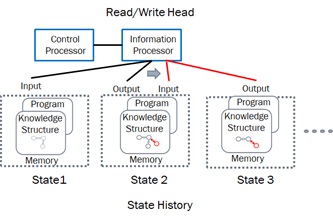
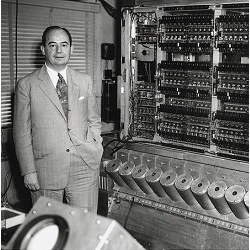
Our mental world has allowed us to develop various means of information processing, communication, and use in our daily lives and businesses we deal with using sophisticated autopoietic and cognitive processes. They help us model the real world, monitor, and manage it to improve sustenance, stability, safety, and survival. The digital world we have created in the process has allowed us to extend our cognitive abilities transcending the physical limitations of ourselves. The digital world, we have created in this process is based on a seventy+-year-old observation by Alan Turing on how humans compute using numbers. The Church-Turing thesis (CTT) translates this observation to current-day general-purpose computers and all the benefits of global connectivity with real-time communication, collaboration, and commerce at scale. CTT states that “a function on the natural numbers is computable by a human being following an algorithm, ignoring resource limitations, if and only if it is computable by a Turing machine.”  The stored program control machine that John von Neumann built became the general-purpose computer that converted information into symbolic data structures and used algorithms to represent the evolution of these data structures as they are used to model the information garnered from the real world. In essence, your computer has some memory and a central processing unit that operates on programs and data representing some knowledge about a particular domain converted into symbols (binary digits, numbers, strings, data structures, etc.)  The program defines an algorithm or task that reads the data and performs operations on them to simulate the evolution of the current state of the domain to the new state. This has allowed us to model real-world processes and automate them (whether they are centralized, distributed, or a hybrid) by monitoring them with physical world interfaces, and managing them based on specific goals.

In addition, various algorithms that mimic the neural networks in the brain to process information have allowed the general-purpose computer to mimic how the brain processes information and gain knowledge about the world using information contained in various forms of data (voice, text, images, and video) just as the reptilian brain uses the five senses to process information from various senses. In short, computers whether using symbols (known as symbolic computing) or neural network algorithms (known as sub-symbolic computing) get information converted into knowledge in the form of symbols and operate on them to simulate the evolution of domain knowledge which could be synchronized with the physical world using appropriate sensing and controlling devices. Humans provide the knowledge in the form of data structures and algorithms, build, operate and manage the fuel for the computation in the form of CPU and memory to process the evolution of domain knowledge.

In summary, as humans, we perceive reality in various forms.  First, we perceive material objects and processes directly or indirectly through our senses, create mental models of reality and interact with them. This is the physical reality in the material world. Second, we create objects and processes in our mental world and interact with them through imagination. This is called imaginary reality in the mental world. Third, we create objects and processes in the digital world and interact with them. Fourth, we create an imaginary world in the digital world and interact with it. This is called virtual reality in the digital world. Just as physical reality and imaginary reality exist in the material world, both physical realities dealing with the material world, and imaginary realities dealing with the imaginary world exist in the digital world.

In a virtual world, we combine our imagination of a fantasy world with the observations from the real world and create a fictional environment that we experience with our senses as we experience the real world. The means of communication, collaboration, and conducting commerce are integrated into the virtual world so that the participants can build their own reality. Since each participant perceives reality from their own mental model of reality, the virtual world is transformed into a complex adaptive system with emergent properties driving its evolution. This brings us to the question, where do we go from here? 

Which Reality do We Perceive? Is It a Choice or Necessity?

Figure 1, provides a mental model of the existence of contemporary human societies and allows us to reflect upon and improve them. The material world consists of structures that are created through the laws of transformation of matter and energy. The material world exists in the form of structures carrying information. Living organisms have designed physical structures in the form of genes and neurons that build other physical structures exploiting the physical and chemical processes, extracting information, transforming it into knowledge, and using it to execute its life processes learned through evolution and natural selection. The digital world is an extension of the physical world, to which the meaning is given by the mental world. It assigns meaning to what the physical structures such ascomputers networks, storage, etc., are produced. The digital structures provide the means to sense the data, extract, and transform information into knowledge. They also provide means to control the devices that are used to change the environment. The virtual world extends our imagination by creating a digital simulation of our mental models that combine reality and fantasy with which we can interact as if we are interacting with a real world. Attempts by big companies such as Facebook, Google, etc., are aimed at making these interactions as real as possible using the digital world. Any improvements we make to the digital world will improve our interactions with the real world and the virtual world.

GTI and TSR provide us with tools to not only understand all these worlds but also to extend and enhance them. In this article, we have reviewed the recent attempts to improve the digital world.  In addition, GTI and TSR allow us to attempt to answer other questions such as:

  1. Can we infuse autopoietic and cognitive behaviors into the digital world? The answer is yes.
  2. How are the ideal structures discussed by Plato’s Ideas/Forms related to various forms of reality?
  3. How do we manage concepts such as good and bad, being and nothingness, selfish and unselfish, etc.
  4. How are consciousness, and culture related?
  5. How did living organisms evolve from being mere physical and chemical structures to developing the complex behaviors of autopoiesis and cognition we observe in all living beings with varying degrees of sentience, resilience, and intelligence?
  6. what is the relationship between the body, mind, autopoietic and cognitive behaviors of living organisms?

Evolution and natural selection have given us the tools not only to use the material world to our advantage but also to understand ourselves as individuals, groups, and form higher-level societies with collective consciousness and culture. How we use it depends on our understanding of the world we live in and how we relate to other worlds.

Conclusion

Two important points I took away from these studies:

  1. Mental structures dealing with knowledge and information are isomorphic to physical structures dealing with matter and energy.  The macroscopic behaviors are the result of microscopic interactions between functions, structure, and fluctuations as Prigogine pointed out. The same is the case with digital structures we implement using digital neurons and digital genes. Macroscopic response time is a consequence of how each individual component is behaving locally impacting global processes. If fluctuations introduced by external forces in the availability of or the demand for the resources that maintain the equilibrium or stability of the structure, cause deviations from equilibrium, the response time fluctuates, and if the fluctuations are large enough the system can be destabilized.  A self-managing system, monitors and prevents disequilibrium by restructuring the network of components. This is the self-management behavior using the regulatory overlay. The digital genome specifies the deployment, monitoring, and managing of the knowledge network to maintain stable response time as an example.
  2. The application workloads from the self-managing network and the digital genome specify and instantiate the distributed application using various resources with the specification of where those resources are available and how to use them. In addition, the specification contains the macroscopic properties, how to monitor them, and manage the goals when fluctuations cause deviations.

This video depicts my view of how a digital genome provides the specification and execution of autopoietic and cognitive behavior in deploying an application workload using the knowledge about the system including how to build the resources, configure, monitor, and manage the stability, safety, sustenance, and survival while performing its mission.

What do We Learn from Cognitive Neuroscience and the Science of Information Processing Structures? What do They Have in Common?

Figure 1: Information Processing Structures in the physical and digital worlds could be represented by named sets, knowledge structures and cognitive apparatuses to model, monitor and manage both the “self” and its interactions with its environment.

“Long before children learn how to read, they obviously possess a sophisticated visual system that allows them to recognize and name objects, animals, and people. They can recognize any image regardless of its size, position, or orientation in 3-D space, and they know how to associate a name to it.”

Stanislas Dehaene (2020) “How We Learn: Why Brains Learn Better than Any Machine…for Now” Viking, an imprint of Penguin Random House, LLC, New York. P 132.

“Moreover, when we assert that a named set (fundamental triad) is the most fundamental structure, it does not mean that it is the only fundamental structure in reality. There are other fundamental structures on different levels of reality. Fields in physics, molecular structures in chemistry, and the DNA structure in biology and genetics are fundamental (basic) in these fields. However, named sets (fundamental triads) form the physical block and constructing element for all those and many other structures. Consequently, named set (fundamental triad) is the most fundamental structure in the world of structures and thus in the whole world”

Burgin, M.S. (2011) “Theory of Named Sets” Nova Science Publishers, Inc. New York. P 599

“The cells in your head are reading these words. Think of how remarkable that is. Cells are simple. A single cell can’t read, or think, or do much of anything. Yet, if we put enough cells together to make a brain, they not only read books, they write them. They design buildings, invent technologies, and decipher the mysteries of the universe. How a brain made of simple cells creates intelligence is a profoundly interesting question, and it remains a mystery.”

Hawkins, Jeff. A Thousand Brains (p. 1). Basic Books. Kindle Edition.

Prologue

This post is aimed at a new generation of computer scientists and information technology professionals and introduces some new directions in which we process, communicate, and use information in real-time to make decisions that impact risk and reward outcomes in everyday life.

Our knowledge of information processing mechanisms stems from three important advances in:

  • Our understanding of the genome, neuroscience and cognitive behaviors of biological systems,
  • Our use of digital computing machines to unravel various mysteries about how our physical world works and to model, monitor and manage it, and
  • A new set of mathematical tools in the form of named sets, knowledge structures, cognizing oracles and structural machines which allow us to not only explain how information processing structures play a key role in the physical world but also to design and implement a new class of digital automata called autopoietic machines which advance our current state of information technologies by transcending the limitations of classical computer science as we practice it today.

This is not a tutorial or a scholarly discourse of these subjects. It is just an attempt as a novice to understand the jargon and try to make sense of the concepts and apply them. Learning is usually, a circular process involving four steps. First as novices, we discover various terms considered as jargon in a new domain. Second, as apprentices, we reflect and study them deeper to connect the dots and understand the new concepts while relating them to our own knowledge. Third, we become experts as we start to apply the concepts in real world and learn from mistakes. Fourth, our knowledge expands as we share this knowledge with others and discover new areas that have not been explored in the boundaries and the process continues. Mastery in a particular domain comes from repeating this process as our knowledge expands.
This post is an attempt to chronical my reflection process as I discover new vocabulary about information, its processing, communication and use from many sources. I am sharing it in the hope that I will discover in the process some new boundaries to explore.

For those with small attention span, here is a summary.

The theories of structural machines, triadic automata, autopoietic machines, and the “knowledge structure” schema and operations on them, so well-articulated, by Prof. Mark Burgin, provide the unified science of information processing structures (SIPS). SIPS allows the transition from data structures to knowledge structures, from Turing machines to Triadic Automata and to computations that go far beyond the boundaries of the Church-Turing thesis dealing with finite resources and their fluctuations. In addition, SIPS provides a cognitive framework that augments current non-transparent deep learning with model based deep-reasoning with deep knowledge, deep memory and experience.

In essence, SIPS helps us in the following three areas:

  1. SIPS provides a theoretical framework to model and explain various findings from neuroscience touched upon in this post. It is possible to bring various theories of how the genome, the genes, neural networks and the brain functions provide autopoietic behavior using cortical columns, reference frames, and models of the “self” and its interactions with the physical world by means of the five senses.
  2. SIPS helps us in designing and implementing a new class of autopoietic machines which go beyond the boundaries of classical computer science paving the path to a new generation of information processing systems while utilizing the current generation systems in the same way as the mammalian brain utilized various functions that the reptilian brain provided to build higher level intelligence.
  3. SIPS allows us to design and implement an intelligent knowledge network, which integrates deep learning, deep memory, knowledge from various domains and provides a framework for deep reasoning to sense and act in real-time for maintaining stability and managing the risk/reward based behaviors of the system.

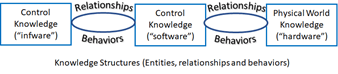
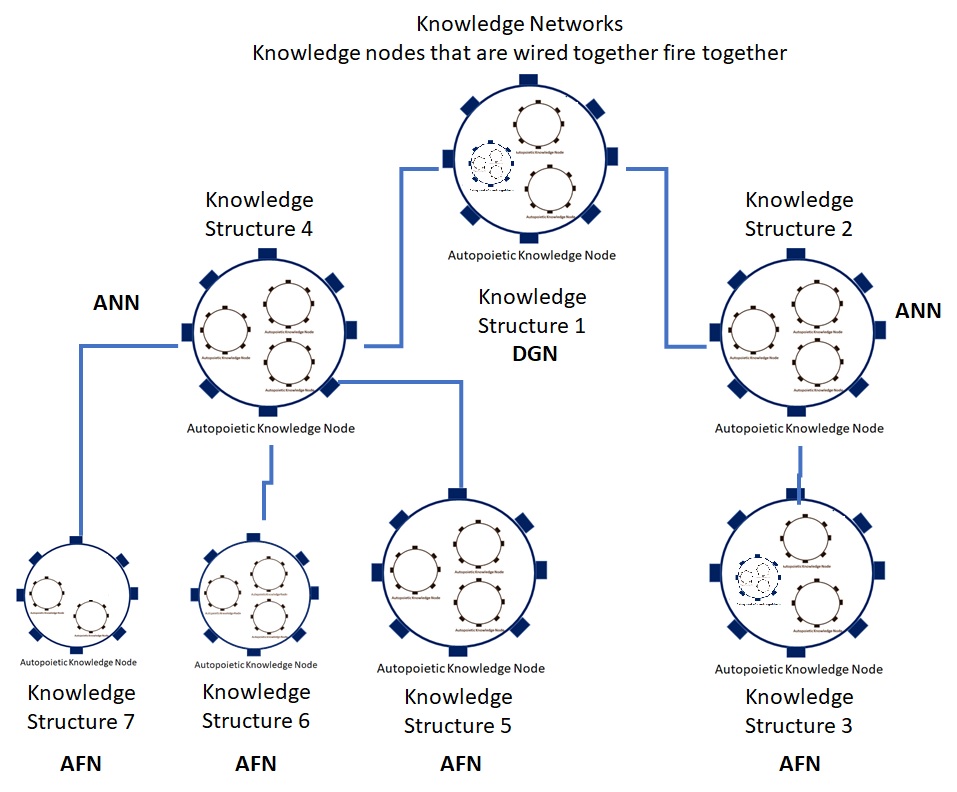
Autopoietic machines are built using the knowledge network, which consists of knowledge nodes and information sharing links with other knowledge nodes. The knowledge nodes that are wired together fire together to manage the behavioral changes in the system. Each knowledge node contains hardware, software and infware (a word introduced by Prof. Mark Burgin in his book on superrecursive algorithms [21]) managing the information processing and communication structures within the node. There are three types of of knowledge nodes depending on the nature of infware:

  1. An autopoietic functional node (AFN) provides autopoietic component information processing services. Each node executes a set of specific functions based on the inputs and provides outputs that other knowledge nodes utilize.
  2. An autopoietic network node (ANN) provides operations on a set of knowledge nodes to configure, monitor and manage their behaviors based on the group-level objectives.
  3. A digital genome node (DGN) is a system-level node that configures a set of autopoietic sub-networks, monitors them and manages their behaviors based on the system-level objectives.

Each knowledge node is specialized with its infware defining the knowledge structures, which model downstream entities/objects, their relationships and behaviors which are executed using appropriate software and hardware. The infware contains the the knowledge for obtaining resources, configuring, executing, monitoring, and managing the downstream components based on the node level objectives.

Figure 2: The Knowledge Network

Figure 2 depicts the structure of a knowledge network implemented in the form of a DGN which in turn is composed of two ANNs. Each ANN manages downstream AFNs. The AFN is designed to execute appropriate software and hardware to deliver the functional behaviors. The hardware and software resources are obtained from conventional computing structures (IaaS, PaaS and application workloads).

Introduction

As Stanislas Dehaene [1] points out “Every single thought we entertain, every calculation we perform, results from activation of specialized neuronal circuits implanted in our cerebral cortex. Our abstract mathematical constructions originate in the coherent activity of our cerebral circuits, and of the millions of other brains preceding us that helped shape and select our current mathematical tools.”
Individual thoughts, concepts, and the number sense arising from neural activity are composed into higher level complex structures which rise through our consciousness and are communicated through our cultures to propagate via a multitude of individual brain structures that use them and even refine them. Resulting mathematical structures are now allowing us to decipher the way brain structures function aided by the experimental observations using positron emission tomography (PET) and functional magnetic resonance imaging (fMRI) experiments on how brain codes our thoughts.


“There is a story about two friends, who were classmates in high school, talking about their jobs. One of them became a statistician and was working on population trends. He showed a reprint to his former classmate. The reprint started, as usual, with the Gaussian distribution and the statistician explained to his former classmate the meaning of the symbols for the actual population, for the average population, and so on. His classmate was a bit incredulous and was not quite sure whether the statistician was pulling his leg. “How can you know that?” was his query. “And what is this symbol here?” “Oh,” said the statistician, “this is pi.” “What is that?” “The ratio of the circumference of the circle to its diameter.” “Well, now you are pushing your joke too far,” said the classmate, “surely the population has nothing to do with the circumference of the circle.””


This story is from Eugene Wigner’s talk [2] titled “The Unreasonable Effectiveness of Mathematics in The Natural Sciences.” He goes on to say “The first point is that mathematical concepts turn up in entirely unexpected connections. Moreover, they often permit an unexpectedly close and accurate description of the phenomena in these connections. Secondly, just because of this circumstance, and because we do not understand the reasons of their usefulness, we cannot know whether a theory formulated in terms of mathematical concepts is uniquely appropriate.”
Once again mathematics has shown up in an unexpected connection dealing with information processing structures. We describe here the new mathematics of named sets, knowledge structures, generalized theory of oracles and structural machines and how they allow us to advance digital information processing structures to become sentient, resilient and intelligent. Sentience comes from the Latin sentient-, “feeling,” and it describes things that are alive, able to feel and perceive, and show awareness or responsiveness. The degree of intelligence (the ability to acquire and apply knowledge and skills) and resilience (the capacity to recover quickly from non-deterministic difficulties without requiring a reboot) depend on the cognitive apparatuses the organism has developed.


While there are many scholarly books, articles and research papers published in the last decade explaining both the theory and few novel implementations [3] that demonstrate the power of the new mathematics dealing with information processing structures, they are not yet understood well by many. There is a reluctance on the part of classical computer scientists and current day information technology practitioners to ignore warnings about the limitations of classical computer science when dealing with information processing structures and large fluctuations disturbing them.


Here is an open secret that is up for grabs for any young computer scientist or IT professional with curiosity to make a major impact in shaping next generation information processing systems which are “truly” self-managing and therefore, sentient, resilient and intelligent. What one needs is an open mind and a willingness to challenge the status-quo touted by big companies with lot of money and marketing prowess. In this post, I will try to articulate what I understood from reading about recent advances in the theory of how biological structures process information and the new science of information processing structures that allow us to design autopoietic systems that imitate them. The term autopoiesis refers to a system capable of reproducing and maintaining itself. “An autopoietic machine is a machine organized (defined as a unity) as a network of processes of production (transformation and destruction) of components which: (i) through their interactions and transformations continuously regenerate and realize the network of processes (relations) that produced them; and (ii) constitute it (the machine) as a concrete unity in the space where they (the components) exist by specifying the topological domain of its realization as such a network.

What do We Learn from Cognitive Neuroscience?

An excellent perspective on the latest contributions of cognitive psychology, neuropsychology, and brain imaging to our understanding of learning and consciousness is given by Dehaene and Naccache [4]. Recent understanding of how the brain functions, reveals that:

  1. Number sense is the result of an innate brain activity: Numerical knowledge is embedded in a panoply of specialized neuronal circuits, or “modules.” More likely, a brain module specialized for identifying numbers is laid down through the spontaneous maturation of cerebral neuronal networks, under direct genetic control, and with minimal guidance from the environment [5].
  2. Reading is an evolutionary outcome of the adaptation of brain circuits using plasticity of the brain: According to Stanislas Dehaene [6] “Reading, although a recent invention, lay dormant in for millennia within the envelope of potentially inscribed in our brains. Behind the diversity of human writing systems lies a core set of universal neuronal mechanisms that, like a watermark, reveal the constraints of human nature.”
  3. Knowledge about itself and its interactions with the environment is distributed in the brain with connections between thousands of complimentary models [7]: “Reference frames are not an optional component of intelligence; they are the structure in which all information is stored in the brain. Every fact you know is paired with a location in a reference frame. To become an expert in a field such as history requires assigning historical facts to locations in an appropriate reference frame. Organizing knowledge this way makes the facts actionable. Recall the analogy of a map. By placing facts about a town onto a grid-like reference frame, we can determine what actions are needed to achieve a goal, such as how to get to a particular restaurant. The uniform grid of the map makes the facts about the town actionable. This principle applies to all knowledge.”
  4. Consciousness is a brain-wide information sharing activity [8]: “In fact, consciousness supports a number of specific operations that cannot unfold unconsciously. Subliminal information is evanescent, but conscious information is stable—we can hang our hat on to it as long as we wish. Consciousness also compresses the incoming information, reducing an immense stream of sense data to a small set of carefully selected bite-size symbols. The sampled information then can be routed to another processing stage, allowing us to perform carefully controlled chains of operations, much like a serial computer. This broadcasting function of consciousness is essential. In humans, it is greatly enhanced by language, which lets us distribute our conscious thoughts across the social network.”

In this section, we will elaborate on some of these observations and identify the common abstractions required for modeling autopoietic structures that represent knowledge about themselves and their environment along with their process evolution behaviors. In the next section we will discern the new mathematics of information processing structures that allow us to represent the models of information processing structures with generalized schemas for autopoietic machines and operations on them. These models then allow us to create a cognitive framework that explains how consciousness works as an autopoietic information processing structure. It should explain global information sharing among autonomous, concurrent and distributed processes which are autopoietic. These components execute functions (as nodes in a network), and form the structure (the nodes sharing information via communication links) and process behaviors specifying their evolution based on the interactions among themselves and their environment. The cognitive framework in the form of a network of networks allows modeling, representing knowledge structures and manage their evolution in the face of rapid fluctuations in the interactions among the components and their environment.

Number Sense as an Information Processing Structure:

All living beings are born with a basic number sense. According to Stanislas Dehaene [1], babies’ numerical inferences seem to be completely determined by the spatiotemporal trajectory of objects. “The newborn’s brain apparently comes equipped with numerical detectors that are probably laid down before birth. The plan required to wire up these detectors probably belongs to our genetic endowment. Indeed, it is hard to see how children could draw from the environment sufficient information to learn the numbers one, two, and three at such an early age. Even supposing that learning is possible before birth, or in the first few hours of life—during which visual stimulation is often close to nil—the problem remains, because it seems impossible for an organism that ignores everything about numbers to learn to recognize them. It is as if one asked a black-and-white TV to learn about colors! More likely, a brain module specialized for identifying numbers is laid down through the spontaneous maturation of cerebral neuronal networks, under direct genetic control, and with minimal guidance from the environment. Since the human genetic code is inherited from millions of years of evolution, we probably share this innate protonumerical system with many other animal species”

In addition, the infant brain seems to be coded to rely on three fundamental laws. First, an object cannot simultaneously occupy several separate locations. Second, two objects cannot occupy the same location. Finally, a physical object cannot disappear abruptly, nor can it suddenly surface at a previously empty location; its trajectory has to be continuous.

Starting from the basic mental representation of numerical quantities that we share with animals, the numerical efficacy evolves with brain structures that support oral numeration, and written numeration. Obviously, cultural intervention of the evolution of human brain helped shape the brain structures to improve the efficacy. “Across centuries, ingenious notation devices have been invented and constantly refined, the better to fit the human mind and improve the usability of numbers.”

Information processing structures and the Learning Process

What is learning and how do we learn? How do babies observe the world and learn to deal with themselves as an object and its relationship with all other objects outside of themselves? Before we start teaching machines how to learn, we should first, understand how sentient beings learn. This is the subject of the very insightful book [16] “How We Learn.” I will summarize few learnings I gleamed from this book that are relevant to my understanding of how information processing structures encoded in the genome play a role in learning and how they are relevant to designing the digital genome which allows us to create autopoietic machines. The new class of digital autopoietic machines go beyond the current state of the art in designing information processing machines using symbolic computing and neural networks based on classical computer science[1].

According to Stanislas Dehaene [16], “to learn is to progressively form, in silicon and neural circuits alike, an internal model of the outside world.” The brain in order to accomplish this, has a “structured yet plastic system with an unmatched ability to repair itself in the face of a brain injury and to recycle its brain circuits in order to acquire skills unanticipated by evolution.” 

The brain uses a set of neural structures that sense, collect, classify, and store information in the form of composable knowledge structures (a network of neural circuits modeling the objects, their relationships and behaviors) and uses them to generate hypotheses and reasoning also conceived and stored in the form of knowledge structures. The reasoning structures allow synchronizing the models with external reality using the compositional nature of these knowledge structures and correcting the models based on error-feedback. The richness of these models and their use in real-time information acquisition, storing, processing and taking action, provide the foundation for the genome-based living organism’s sentient, resilient and intelligent behaviors.

The genome provides a basic set of knowledge structures that have been created through the cellular evolution processes. For example, “at birth, baby’s’ brains are already organized and knowledgeable. They know, implicitly that the world is made of things that move only when pushed, without ever interpenetrating each other (solid objects) – and also that it contains much stranger objects that speak and move by themselves (people).” The genome contains the internalized knowledge of preceding generations in the form of hardwired genes and neural networks. The genome encodes in its DNA several kinds of knowledge structures:

  1. The knowledge structures required to use physical and chemical resources and processes to create both physical and cognitive structures of the cellular being with autopoietic behavior.
  2. The knowledge structures that provide the sense and perception using various physical structures belonging to the “self.”
  3. The knowledge structures that model, monitor and manage the stability of the overall “body” structure (the life’s processes) and
  4. The knowledge structures that map the relationships and behaviors of the body and the environment.

In the next section we will discuss our learnings from the studies of the brain and the neocortex using PET and FMRI and their relationship to the knowledge structures.

Distributed Knowledge Networks as Information Processing Structures

The book “A Thousand Brains” [7] provides a detailed map of how brain structures sense, classify, model and manage information about the body and its interactions with the environment. I will try to summarize my learnings from reading this book.

  1. Our intelligence stems from the activities in our brain consisting of two parts, an old brain and a new brain called the neocortex which are connected to each other and communicate through nerve fibers.
  2. “The neocortex is the organ of intelligence. Almost all the capabilities we think of as intelligence—such as vision, language, music, math, science, and engineering—are created by the neocortex.”
  3. The neocortex provides the framework for modeling the body and the outside world with which it interacts using the older brain that is directly connected to various parts of the body and manages the inputs and outputs through the five senses. The neocortex acts as a “sixth sense” by modeling, monitoring and managing the body and the external world.
  4. Thoughts, ideas, and perceptions are the activity of the neurons that are connected to each other and everything we know is stored in the connections between neurons. These connections store the model of the world that we have learned through our experiences. Every day we experience new things and add new pieces of knowledge to the model by forming new synapses. The neurons that are active at any point in time represent our current thoughts and perceptions.
  5. “The word “model” implies that what we know is not just stored as a pile of facts but is organized in a way that reflects the structure of the world and everything it contains.” Modeling objects, their internal structures and their interactions are modeled as entities, relationships and behaviors. A behavior is a series of activities that take place in the system in response to a particular situation or stimulus
  6. “The old brain contains dozens of separate organs, each with a specific function. They are visually distinct, and their shapes, sizes, and connections reflect what they do. For example, there are several pea-size organs in the amygdala, an older part of the brain, that are responsible for different types of aggression, such as premeditated and impulsive aggression.” In essence, the old brain is endowed with its own structure with autonomic components which provide specific functions that are performed using the body. This is accomplished through embedded, embodied, enactive and extended (4E) cognition models of their own using the cortical columns. There are about 150,000 of these columns which in their world-modeling activities, work semi-autonomously.
  7. The neocortex learns a predictive model of the world (including the “self”) and these predictions are the result of structural reconfiguration of the neural networks.
  8. The predictive model is created using the cortical column’s ability to represent knowledge in the form of “reference frames.” “A reference frame tells you where things are located relative to each other, and it can tell you how to achieve goals, such as how to get from one location to another. We realized that the brain’s model of the world is built using map-like reference frames. Not one reference frame, but hundreds of thousands of them. Indeed, we now understand that most of the cells in your neocortex are dedicated to creating and manipulating reference frames, which the brain uses to plan and think.” This observation is very relevant in designing and implementing autopoietic machines using digital computers.
  9. A collection of reference frames provides a means to model various entities and objects, their relationships and movement and other behaviors that change the state of the world from one instant to another. The difference between an entity and an object is that the entity is an abstract concept with attributes such as a computer with memory and CPU. An object is an instance of an entity with an identity, with two components which are the state and behavior.

The important lesson I take away from these observations is that the neocortex provides an integration of models of the “self” and its interactions with the external world developed  across all knowledge acquired through myriad semi-autonomous cortical columns. It provides a predictive framework in real-time to sense and act based on changes in its perception of the current state of the global model.

Consciousness as an information processing structure designed for global optimization:

While consciousness is a very complex and controversial subject, we discern some common themes from both Jeff Hawkins and Stanislas Dehaene writings [7, 8 and 16].

  1. The controversy about our understanding of consciousness stems from two schools of thought. One in which the consciousness may involve science that goes beyond mere result of neural activity and the other in which it is the consequence of physical phenomenon like any other and is eventually understood with a proper theory that is consistent with observations. Suh theories are emerging [10, 16, 17] based on recent observations with FMR and PET studies. A very interesting video summarizes some of these efforts and is very illuminating (https://youtu.be/efVBUDnD_no )
  2. The emerging model of the brain consisting of the old reptilian brain and the new mammalian brain and their interactions with “self” and the external world is throwing light on the nature and role of consciousness. The old brain with a multitude of semi-autonomous cortical columns is designed to process information from a multitude of sources filtered through the five senses of the body. The efficiency of these structures is achieved through specialization, separation of concerns and adaptation through 4E cognitive processes. These cognitive processes allow the cortical columns to create models of complex objects they sense and their movement. The information received through the senses is transformed into knowledge in the form of a neural network consisting of several hundred neurons where each neuron is associated with a specific function required to model observed features, locations and the movements. The cortical columns are designed to optimize their tasks in performing the local mission. An interesting feature of cortical columns is that they all use same mechanism of modeling knowledge independent of the sensory mechanisms from which the information is being received or the nature of the content. It is the structure and its configuration that matter to create reference frames.
  3. The new brain is designed to process information and create a global model of the “self” and its interactions with the outside through the received models from the old brain. In addition, the new brain has to resolve any disputes that arise between the old brain cognitive functions and provide global optimization of the system evolution with predictive reasoning based on global knowledge and history stored in memory in the form of neural networks.
  4. According to Stanislas Dehaene [8], “conscious perception transforms incoming information into an internal code that allows it to be processed in unique ways.” It fulfills an operational role. “Consciousness implies a natural division of labor. In the basement, an army of unconscious workers does the exhausting work, sifting through piles of data. Meanwhile at the top, a select board of executives, examining only a brief of the situation, slowly makes conscious decisions.”

The cognitive overlay, self-regulation to achieve global optimization based on a consensus approach between all the participant components deal with contention for resources, prioritization of various tasks, synchronizing various distributed autonomous processes where necessary etc.  These tasks are accomplished using the abstractions of addressing of various components, alerting, mediation and supervision. Self-regulation rules are derived from the knowledge structures representing the history and genomics. Global awareness and shared knowledge allows avoiding the pitfalls of self-referential circularity not moored to external reality and paves the path for global optimization of system behavior in the face of non-deterministic fluctuations caused by external forces.

What do We Learn from the Science of Information Processing Structures?

Computing, communication, cognition, consciousness and culture are the essential ingredients of information processing structures and the process of evolution has generated myriad structures with varying degrees of sentience, resilience and intelligence. All forms of physical structures deal with functions, their composition from groups to semigroups, and from trajectories to processes through various interactions and their reaction to fluctuations which cause disturbances. Physical and chemical systems evolve through matter and energy transformations subject to laws of physics.  Information processing and communication are subject to laws of energy and entropy of the structure interacting with its external environment and forces. Biological systems, in addition, have developed cognitive capabilities through their cognitive apparatuses – the gene and the neuron.  The evolution of the genome leveraging the genes and the neuronal structures has given rise to autopoiesis, consciousness and culture. In this section, we will analyze the new mathematics of structural machines and apply it to understand the fundamental nature of information processing structures and their properties.

Function, Structure and Fluctuations

The physical universe, as we know it, is made up of structures that deal with matter and energy. As Mark Burgin [9] points out energy and matter are different but intrinsically connected with one another. Matter cannot exist without energy (at least, zero energy), while energy is always contained in physical bodies. Taking matter as the name for all physical substances as opposed to energy and the vacuum, we have the relation that is represented by the following diagram (reflected in figure 3).

Similarity of matter and knowledge means that they may be considered in a static form, while energy and information exist only in (actual or potential) dynamics. In addition, similarity of energy and information signify that both these entities cause change in systems: energy does this in physical systems, while information does this in structural systems such as knowledge and data. In other words, the diagram states that information is related to knowledge and data as energy is related to matter. More exactly, this relation holds for cognitive information that changes such infological system as thesaurus or system of knowledge.

Figure 3: Matter-Energy and Information-Knowledge/Data Relationships

Information processing structures in the physical world are formed through the physical and chemical processes available in nature using matter, energy and their transformation rules. Atoms are composed into molecules and molecules are composed into  compounds. Component functions, composed structures and fluctuations in their interactions among the components themselves and their external environment determine their macroscopic properties. For example, as the kinetic energy increases (because of heat from external source for example), the structure of a set of water molecules is rearranged going form solid form to liquid form or from liquid form to a gaseous form through physical processes. Same holds true for chemical structures when different physical structures interact with each other and form a composed structure using matter and energy transformations. The structure, strength of the interactions and the nature of fluctuations determine their evolution. Such structures can be represented by state vectors in phase space and their dynamics is determined by well-defined mathematical structures that deal with matter, energy and their transformation rules defined by the physical processes. Mathematical representations of these structures stem from the rotational and translation invariance properties in the complex space-time manifold.

A complex adaptive system (CAS) is a structure that consists of a network of individual entities interacting with each other and its environment. Each entity exhibits a specific behavior (function) and may be composed of subnetworks of entities (structure) providing a composed behavior. It takes energy to process information, sustain its structure and exhibit the intended behavior. Various systems adapt different strategies to use matter and energy to sustain order in the face of fluctuations caused by internal or external forces. The second law of thermodynamics comes into play because of matter and energy involvement which states that “there is no natural process the only result of which is to cool a heat reservoir and do external work”. In more understandable terms, this law observes the fact that the useable energy in the universe is becoming less and less. Ultimately there would be no available energy left. Stemming from this fact, we find that the most probable state for any natural system is one of disorder. All-natural systems degenerate when left to themselves. However, an adaptive system refuses to be “left to itself” and develops self-organizing patterns seeking minimum entropy states to reconfigure the structure in order to compensate for the deviations of behavior from stable equilibrium due to fluctuations. Thus functions, structures, interactions, fluctuations, and reconfiguration processes play key roles in the evolution of CAS.

Living beings, on the other hand exhibit sentience along with some form of intelligence and resilience. The cognitive apparatuses are built using information processing structures that exploit physical, chemical and biological processes in the framework of matter and energy. These systems transform their physical and kinetic states to establish a dynamic equilibrium between themselves and their environment using the principle of entropy minimization. Biological systems have discovered a way to encode the processes and execute them in the form of genes, neurons, nervous system, the body and the brain etc., through evolutionary learning. The genome, which is the complete set of genes or the genetic material present in a cell or in an organism, defines the blueprint that includes instructions on how to organize resources to create the functional components, organize the structure and the rules to evolve the structure while interacting with environment using the encoded cognitive processes. Placed in the right environment, the cell containing the genome executes the processes that manage and maintain the self-organizing and self-managing structure adopting to fluctuations.

Any theory of the biological processes must explain the autopoietic behavior and the structures designed, built, monitored and managed in real-time to establish and maintain stability in the face of fluctuations in the interactions both within and with its environment.

In the next section, we will examine a new theory of autopoietic structures and how it fares in explaining the autopoietic processes and help design also a new class of autopoietic automata going beyond classical computer science.

Named Sets as Elements of Information Processing Structures

Structural relationships exist between data, which are entities observed in the physical world or conceived in the mental world. These structures define the knowledge of them in terms of their properties such as attributes, relationships and dynamics of their interaction. Information processing structures organize evolution of knowledge structures by an overlay of cognitive knowledge structures, which model, monitor and manage the evolution of the information processing system. The most fundamental structure is called a fundamental triad or a named set [10]. It has the following visual representation shown in Figure 4:

Figure 4: Visual representation of a fundamental triad (named set)

At the lowest level, the data elements are generally represented by a key, value pair. They are domain dependent and represent some knowledge about the domain. For example, glucose level in a person’s body has a value. Similarly, Sugar level of the person has a value. At the next level, some of the data elements have a relationship to other elements.  Some elements change depends on the changes of other elements. For example, the risk of diabetes of a person depends on the levels of sugar and insulin of that person. This information provides a model that represents the knowledge structure and changes in the knowledge structure provides new information.

Figure 5 shows the knowledge structure related to the risk of diabetes, and the levels of sugar and insulin.

Figure 5: Domain-specific micro knowledge structure schema with entities, their relationships and all possible behaviors when events change their values

The knowledge structure bears similarity to the cortical column [7] with observed features, their impact on the objects with their locations, relationships and behaviors.  Micro-knowledge structures as named sets and their composition into macro knowledge structures provide a model to represent our knowledge about the world.

The Role of Knowledge Structures in Information Processing

A knowledge structure [11 – 13] is composed of related fundamental triads (named sets), and any state change causes behavioral evolution based on the connections. The long and short of the theory of knowledge is that the attributes of objects in the form of data and the intrinsic, and ascribed knowledge of these objects in the form of algorithms and processes, make up the foundational blocks for information processing. Information processing structures utilize knowledge in the form of algorithms and processes that transform one state (determined by a set of data) of the object to another one with a specific intent. Information structures and their evolution using knowledge and data determine the flow of information. Living organisms have found a way not only to elaborate the knowledge of the physical objects, but also to create information processing structures that assist them in executing state changes. Representation of knowledge structures and operations on their schema are detailed in two papers [14, 15] describing their relationship to the design of autopoietic machines. There are two kinds of knowledge structures that enable autopoietic behaviors:

  • Micro-knowledge structures that contain schema for modeling, and executing lowest level functions of the components of the autopoietic system. In the case of the brain and the body, these are equivalent to the cortical columns that process myriad data from different sources (the senses) and create the reference frames. In the case of digital information processing systems these are the micro-services that provide computations required to fulfill functional requirements of the system and are designed in the form of algorithms to be executed in a computing machine (a general purpose computer with required CPU and memory).
  • In both biological and digital autopoietic systems, these micro-knowledge structures contain functions that discover the resources required, assemble the right structures necessary to execute the microservices defined by the blueprint.
  • Macro-knowledge structures that contain schema for modeling the knowledge of the self and its interactions with the world. In the case of the brain, the schema contain the entities, relationships and behaviors depicting the body and its interactions with the world. In the case of digital information processing systems, the schema contain the entities, relationships and behaviors of both the functional requirement execution knowledge and the non-functional requirements knowledge.

The Role of Cognizing Agents or Generalized “Oracles” in Information Processing

Alan Turing in his thesis introduce the “oracle” [18] as a device that supplies a Turing machine with the values of some function (on the natural numbers or words in some alphabet) that is not recursively, e.g., Turing-machine, computable. Burgin and Mikkilineni [19] showed that the Turing Oracle could be generalized to  allow corrections to manage the deviations from the intent of computations from an external viewpoint and could be exploited to create a monitoring and control system to infuse cognition into computing. An implementation of the Turing oracle was utilized in implementing the distributed intelligent managed element (DIME) network architecture to demonstrate self-managing distributed computing processes [20]. The video demonstrates the application of the oracle concept to create a multi-cloud orchestrator to state-fully manage, migrate and scale workloads across multiple clouds. https://youtu.be/tu7EpD_bbyk

While this approach provided migration of workloads from one cloud to another without disturbing the transactions in progress, the Turing oracle approach used was intrusive in the sense that the computation has to check whether there is any external oracle communication before it proceeds with computation. In addition, the computation itself has no way to communicate with the oracle to influence globally distributed computations with its local knowledge. In essence, the computation has no visibility to the intent except executing the algorithms specified in its program. In the next section, we see that the generalized oracles combined with the knowledge structures and structural machines provide a more powerful information processing structure with autopoiesis that allows the specification of the intent and its life-cycle management in the face of fluctuations that cause deviations.

Structural Machines, Triadic Automata and Information Processing Structures

Triadic automata, and autopoietic machines introduced by Burgin [14, 15] allow us to design a new class of distributed information processing structures that use infware containing hierarchical intelligence to model, manage and monitor distributed information processing hardware and software components as an active graph representing a network of networked processes. An autopoietic system implemented using triadic structural machines, i.e., structural machines working as triadic automata, is capable of “of regenerating, reproducing and maintaining itself by production, transformation and destruction of its components and the networks of processes downstream contained in them.” The autopoietic machines which operate on schema containing knowledge structures allow us to deploy and manage non-stop and highly reliable computing structures at scale independent of whose hardware and software are used. Figure 6 shows the structural machine operating on the knowledge structure in the form of an active graph in contrast to a data structure in the Turing Machine implementation, which is a linear sequence of symbols.

Figure 6: The schema in a triadic automaton represents a knowledge structure containing various objects, inter-object and intra-object relationships and behaviors that result when an event occurs changing the objects or their relationships

It is important to emphasize the differences between data, data structures and knowledge structures. Data are mental or physical “observables” represented as symbols. Data Structure defines the relationships between data items. Knowledge structures on the other hand, include data structures abstracted to various systems, inter-object and intra-object relationships and behaviors that result when an event occurs changing the objects or their relationships. The inclusion of behaviors in the knowledge structures and the operations on the knowledge structure schema described by Prof. Burgin provides the composability and the ability of the wired networks to fire together to represent the state of knowledge and its evolution.

How Do We Use the Learnings from Neuroscience and the Mathematics of information Processing Structures to Design a New Class of Digital Autopoietic Machines?

We learn from neuroscience that the “neurons that fire together wire together.” We propose the corollary – the nodes that are wired together fire together – which allows us to explain the knowledge structures. The knowledge structure is a network of networks composed of subnetworks, each with nodes processing information and communicating with other nodes through links. The nodes contain information processing structure that models the physical and mental models of information in the form of entities/objects, their relationships and behaviors that influence each other when changes occur.

Some nodes are similar to the cortical columns in the old brain with specialized services that sense, process and manage information in the local domain to create the knowledge about itself and its relationship to the external world. The subnetworks formed with links to other nodes provide the communication of changes that impact the wired subnetwork. Subnetworks thus provide combined knowledge structure representing higher level composed behaviors.

Other nodes with regulatory knowledge structures are like the modules in the neocortex that provides global sharing of knowledge, deep memory of the system with history and deep reasoning modules that provide predictive analytics and risk management behaviors that provide global optimization of the system evolution.

Can we use this knowledge to:

  • Model and explain how cognitive processes in the living organisms work, and
  • Design and implement a new class of digital automata that include models of themselves and their environment and exhibit autopoietic behavior?

Epilogue

Figure 7: The Anatomy of a knowledge structure

On one hand, we are beginning to understand how the genome encodes the knowledge of how to use physical and chemical processes in the physical world and create structures that process information in real-time to build a “self” with unique identity, model both the “self” and its interactions with the physical world outside, monitor and manage its evolution. The autopoietic behavior of biological
systems arise from the triadic structures consisting of the knowledge depicted in figure 7. The “hardware” [21] consists of the physical world knowledge structures that depict the entities (and objects), their relationships and behaviors in the physical world. The “software” consists of the control knowledge structures that depict the entities (and objects), their relationships and behaviors to sense, model and manage the physical world through 4E cognitive processes. The “infware” consists of the control knowledge that depict the entities (and objects), their relationships and behaviors that constitute an autopoietic entity (the “self”) that has an intent and the knowledge to achieve that intent by using the software to sense and manage the physical world.

Figure 8 shows how the knowledge network is organized. The nodes that are wired together fire together to execute the behavioral changes that optimize risks and rewards based on both local and global constraints. The goal of the system is defined in the digital genome and the predictive behaviors dictate methods for global optimization.

Figure 8: The knowledge network

On the other hand, we also have a new theory of information processing structures [15] which allows us to not only provide a theoretical understanding of how the autopoietic behavior of biological systems, but also design a and implement a new class of digital automata that are autopoietic. This post and the conference (www.tfpis.com ) are aimed at starting a discussion that may help us move from classical computer science and its limitations to the new science of information processing structures which allows us not only understand how brain learns and uses the knowledge to maintain and manage the stability and survival of the “self” but also to design and implement a new class of machines that learn and use the knowledge to provide an extension of 4E cognition with a collective consciousness.

References

[ 1] Dehaene, Stanislas. (2011). “The Number Sense: “How the Mind Creates Mathematics” Revised and Updated. Oxford University Press. Kindle Edition. P. 15.

[ 2] Wigner E.: (1960) “The Unreasonable Effectiveness of Mathematics in the Natural Sciences,” in Communications in Pure and Applied Mathematics, vol. 13, No. I (February 1960). New York: John Wiley & Sons, Inc. wigner.pdf (ed.ac.uk)

[ 3] Burgin, M.; Mikkilineni, R. Cloud computing based on agent technology, super -recursive algorithms, and DNA. Int. J. Grid Util. Comput. 2018, 9, 193–204.

[ 4] Dehaene, S., & Naccache, L. (2001). Towards a cognitive neuroscience of consciousness: Basic evidence and a workspace framework. Cognition, 79, 1 – 37.

[ 5] Dehaene, Stanislas. The Number Sense (p. 93). Oxford University Press. Kindle Edition. p 93.

[ 6] Dehaene, Stanislas. (2010). “ Reading in the Brain: The New Science of How we Read” Revised and Updated. Penguin Books, New York. P. 10.

[ 7] Jeff Hawkins, (2021). “A Thousand Brains: A New Theory of Intelligence.” Basic Books, New York.

[ 8] Dehaene, Stanislas. (2014). “ Consciousness and the Brain: Deciphering How the Brain Codes Our Thoughts” Penguin Group, New York.

[ 9] M. Burgin, (2003) Information: Problems, Paradoxes, and Solutions. tripleC 1(1): 53-70. ISSN 1726-670X DOI: https://doi.org/10.31269/triplec.v1i1.5

[ 10] Dehaene, Stanislas. (2014). “ Consciousness and the Brain: Deciphering How the Brain Codes Our Thoughts” Penguin Group, New York.

[ 11] Mikkilineni R, Burgin M. Structural Machines as Unconventional Knowledge Processors. Proceedings. 2020; 47(1):26. https://doi.org/10.3390/proceedings2020047026

[ 12] Burgin, M. (2010) Theory of Information. Fundamentality, Diversity and Unification. World Scientific Publishing, Singapore. https://www.worldscientific.com/doi/pdf/10.1142/7048

[ 13] Burgin, Mark. (2016) ” Theory of Knowledge.” World Scientific Publishing, Singapore. https://www.worldscientific.com/doi/pdf/10.1142/8893

[ 14] Burgin, M., Mikkilineni, R. and Phalke, V. Autopoietic Computing Systems and Triadic Automata: The Theory and Practice, Advances in Computer and Communications, v. 1, No. 1, 2020, pp. 16-35

[ 15] Burgin, M. and Mikkilineni, R. From Data Processing to Knowledge Processing: Working with Operational Schemas by Autopoietic Machines, Big Data Cogn. Comput. 2021, v. 5, 13 (https://doi.org/10.3390/bdcc5010013 )

[ 16] Dehaene, Stanislas. (2020). “How We Learn: Why Brains Learn Better Than Machine … for Now” Penguin Random House. ISBN 9780525559887

[ 17] Kleiner, J. Mathematical Models of Consciousness. Entropy 2020, 22, 609. https://doi.org/10.3390/e22060609

[ 18] Turing, A. M. Systems of logic defined by ordinals. Proc. Lond. Math. Soc., Ser. 2, 45, pp. 161-228, 1939.

[ 19] Burgin M. and Mikkilineni R. ‘Semantic Network Organization based on Distributed Intelligent Managed Elements’, In Proceeding of the 6th International Conference on Advances in Future Internet, Lisbon, Portugal, pp. 16-20, 2014.

[ 20] R. Mikkilineni, G. Morana, and M. Burgin. “Oracles in Software Networks: A New Scientific and Technological Approach to Designing Self-Managing Distributed Computing Processes,” In Proceedings of the 2015 European Conference on Software Architecture Workshops (ECSAW ’15). ACM, New York, NY, USA, Article 11, 8 pages, 2015.

[ 21] Burgin, M. Super-Recursive Algorithms; Springer: New York, NY, USA; Heidelberg/Berlin, Germany, 2005.

[1] Classical computer science based on John von Neumann’s stored program implementation of the Turing machine has given us the general purpose computer along with both symbolic and neural network based information processing structures. Key limitation of the general purpose computer is described in the book by Cockshott et al. (P. Cockshott, L. M. MacKenzie and G. Michaelson, “Computation and Its Limits,” Oxford University Press, Oxford, 2012.) “The key property of general-purpose computer is that they are general purpose. We can use them to deterministically model any physical system, of which they are not themselves a part, to an arbitrary degree of accuracy. Their logical limits arise when we try to get them to model a part of the world that includes themselves.”

What is Classical Computer Science, and What are its Boundaries?

Dr. Rao Mikkilineni published a Paper in the Turing Centenary Conference (2012) in Manchester (The Turing O-Machine and the DIME Network Architecture: Injecting the Architectural Resiliency into Distributed Computing (easychair.org))

“For millennia, the enigma of the world of Ideas or Forms, which Plato suggested and advocated, has been challenging the most prominent thinkers of the humankind.”

Burgin, Mark. (2018). Ideas of Plato in the Context of Contemporary Science and Mathematics. Athens Journal of Humanities and Arts. 4. 10.30958/ajha.4.3.1.

“The world model provided by the Existential Triad allows us to analyze various processes that go in science. For instance, physicists are trying to create a theory of everything. However, this is impossible because physics studies only physical, i.e., material systems. So, in the best case, physicists will be able to create a theory of everything on the level of physics as the basic scientific reflection of the material world. However, there are higher than physical levels of reality – biological, psychological, and social. Thus, it becomes, for example, questionable that a physical theory can explain all processes and phenomena in society. At the same time, we already know that everything has structure and, as a rule, not a single one. Thus, the general theory of structures is a theory of everything as its studies everything. Now this theory is only at the initial stage of its development and its development requires work of many researchers.”

MLA 8th Edition (Modern Language Assoc.) Burgin, M. S. Structural Reality. Nova Science Publishers, Inc, New York 2011.

Prologue

Over millennia, our view of the world has changed from consisting of a void and a large number of invisible and indivisible particles, which were called atoms (Leucippus of Miletus (ca. 480 – ca. 420 B.C.E.) and Democritus from Abdera (460-370 B.C.E.)) to vacua consisting of strings. While the path has been rocky at times and we still do not know where it leads to, one thing is clear. Human thought continues the search for that unifying theory which is expected to solve the enigma of the world. In the process, we have seen old ideas rejected and reembraced, new ideas scorned and eventually accepted, even if grudgingly. People often, cancelled without mercy and reembraced with regret. Classical computer science falls in the same category as the ideas and forms proposed by Plato, now explained with the theory of structures by Prof. Mark Burgin, or the limitations of Kepler’s deductions from his observations of the planetary trajectories in discovering hidden planets, or the discovery of the boundaries of Newtonian physics as the particle velocities approach the speed of light or the limitations of classical thermodynamics in explaining the phase transitions in matter using statistical mechanics, which addressed the roles of function, structure and fluctuations. The list goes on.

All of these observations have one thing in common. They all point to structures and their dynamics of evolution under the influence of laws of physics as a common denominator. Information is the difference between these structures as they evolve under the influence of interactions among themselves or the interactions with the external world outside of themselves. As Burgin points out:

  1. Information is a fundamental constituent of the universe on par with matter-energy, the missing link in the explanation of all the phenomena of the world.
  2. Information Processing requires Physical Structures
  3. Information to Knowledge is as Energy is to Matter

In this context, we examine the evolution of classical computer science that has made a huge impact in transforming how we live, communicate, collaborate and conduct commerce while at the same time changing the way how we view ourselves and the world we live in. It allowed us to take information processing to new heights and allowed us to unravel the mysteries of the Genome, explain the inconsistencies of various self-consistent logics when they are not moored into external realities and at the same time is causing huge disruptions in our societies with digital divide caused by information processing monopolies.

In this blog, we examine the boundaries of classical computer science as the velocity of information exchange between various entities increases nearing that of the speed of light. The information access and its velocity is creating the haves and have-nots and the haves attempting to control how the have-nots should behave. The outcome of large fluctuations in information access, processing and its use to influence the participants self-interest is analogous to their role in phase transitions in matter or the emergent behavior exhibited in complex adaptive systems. By understanding the limitations of classical computer science, we argue that the fluctuations and their impact can be managed using cognitive overlays just as biological systems do.

In section 2, we describe classical computer science derived from the Turing’s articulation of the Universal Turing Machine and its stored program implementation by John von Neumann. We discuss the Church-Turing Thesis and its limitations as the velocity of information races toward the speed of light among some components of the information processing structures while leaving others out. In Section 3, we discuss the theory of structures, the role of knowledge structures in information processing and the design of autopoietic automata that generalize the Turing Machines to include cognitive overlay for managing fluctuations in the interactions between various components and their environment. In Section 4, we present some observations on the application of the autopoietic automata to design a new class of information processing structures that provide solutions to current issues with state of the art.

What is Classical Computer Science?

Classical computer science, as we practice it today, can be easily said to have its origins emerge from the simple theory of Turing machine (TM) “replacing the man in the process of computing a real number by a machine which is capable of only a finite number of conditions.” Current IT is based on von Neumann’s stored program control implementation of the Turing machine and addresses concurrent and synchronous distributed computations (connected Turing Machines provide sequential computing). As George Dyson so eloquently pointed out “the stored-program, as conceived by Alan Turing and delivered by John von Neumann, broke the distinction between numbers that mean things and numbers that do things. Our universe would never be the same.”

Figure 1: Symbolic computing with stored program control implementation of the Turing Machine

Turing machine has allowed us to create general purpose computers and “use them to deterministically model any physical system, of which they are not themselves a part to an arbitrary degree of accuracy.” While the Turing machine is a mathematical model of computation that defines an abstract machine, which manipulates symbols on a strip of tape according to a table of rules, the stored program implementation of it consists of a central processing unit (CPU), that is used to carry out computations, which reads the input from a memory device, performs the computation defined by an algorithm and writes the output to the memory. Figure 1 shows the stored program implementation of the Turing machine. The algorithm and the data are converted from symbols into sequences of binary digits and are stored in the memory. Each step of the computation involves the CPU reading the instruction from the program, and perform the operation on the input from the memory and write the output in the memory to be read and operated upon by the next instruction. The operation in the form of binary arithmetic depends solely on the input and the operation defined by the algorithm and is completely deterministic.  The evolution of the data halts when there are no more operations to be performed. The operation assumes that there are always enough memory and CPU available for performing the operation.  John von Neumann’s first implementation used vacuum tubes to perform the binary arithmetic operations and magnetic drum used for memory. Current generation of computers use microprocessor chips and various forms of memory that provide very fast computations. Figure 2 shows John von Neumann with his computer.

Figure 2: John von Neumann with his Computer

Turing computable functions are those that are easily described by a list of formal, mathematical rules or a sequence of event driven actions such as modeling, simulation, business workflows, interaction with devices, etc. It is interesting to note that the Turing computable functions also include algorithms that define neural networks, which are used to model processes that cannot be described themselves as algorithms such as voice recognition, video processing, etc. Sub-symbolic computing (neural network computation) is enabled by algorithms implemented using symbolic computing.

A universal Turing machine is just a Turing machine (UTM) whose algorithm simulates other Turing machines. That is, the input to the UTM is a description of a Turing machine T and an input for T, and the UTM simulates T, on that input. It’s universal in the sense that, for any problem that can be solved by Turing machines, you could either use a Turing machine that directly solves that problem, or you could use a UTM and give it the description of a TM that directly solves the problem. In effect, all modern general purpose computers are universal Turing machines. Thus, all general purpose computers are equivalent to one another: the differences between them can be entirely subsumed in the algorithms as long as the resources that are required to execute them are same. It is interesting to note that Turing machines executing algorithms in parallel, if they do not directly communicate with one another achieve no more than having two which do communicate; and if they communicate, then, in effect, they are just a single device! (Penrose, Roger. The Emperor’s New Mind (Oxford Landmark Science) (p. 63). OUP Oxford. Kindle Edition.)

Church-Turing Thesis and its Boundaries

Turing machine models the behavior of “the man in the process of computing a real number” (quote from Turing’s paper) and the stored program implementation provides a cognitive apparatus to mimic the process with a machine.

All algorithms that are Turing computable fall within the boundaries of Church Turing thesis which states that “a function on the natural numbers is computable by a human being following an algorithm, ignoring resource limitations, if and only if it is computable by a Turing machine.” The resources here are the fuel for computation consisting of the CPU and memory.

According to Jack Copeland and Onan Shagrir, “the Church-Turing thesis (CTT) underlies tantalizing open questions concerning the fundamental place of computing in the physical universe. For example, is every physical system computable? Is the universe essentially computational in nature? What are the implications for computer science of recent speculation about physical uncomputability? Does CTT place a fundamental logical limit on what can be computed, a computational “barrier” that cannot be broken, no matter how far and in what multitude of ways computers develop? Or could new types of hardware, based perhaps on quantum or relativistic phenomena, lead to radically new computing paradigms that do breach the Church-Turing barrier, in which the uncomputable becomes computable, in an upgraded sense of “computable”?

There are at least, three possible arguments pointing to the limitations of CTT:

  1. Dealing with functions that are not effectively calculable: As Turing showed, there are uncountably many such functions. It is an open question whether a completed neuroscience will need to employ functions that are not effectively calculable. Does human brain in addition to processing calculable functions, utilize other mechanisms to process information involving functions that are not effectively calculable. How do we model them with machines?
  2. Dealing with concurrent computing processes that model and manage the physical world using various Turing machine implementations that interact with each other and their environment through a multitude of sensors and actuators: Various levels of abstractions in dealing with program and data in the general purpose computer from 1’s and 0’s at the lowest level to symbols, strings, languages and process schema that define structures and operations on them, have allowed us to graduate from mere computing numbers to information transformation, or operations on multimedia, such as text, audio or video data and finally to computers as mediators and facilitators of interactions between autonomous concurrent and distributed computing processes. The evolution of computing structures as complex adaptive systems pose issues dealing with dynamical changes in the organization and composition to accommodate mobility or evolve and be reconfigured to adapt changes in the interactions that are non-deterministic.
  3. Dealing with large fluctuations in the demand for and the availability of the computing fuel (CPU and memory): CTT inherently ignores resource limitations for executing the algorithms. However, general purpose computers come with finite resources and the fluctuations in the demand for resources when the computations require more memory or computational speed need immediate attention lest the computation halts.

In this section we will examine these boundaries.

Dealing with Functions That are not Effectively Calculable:

As Oran Shagrir summarizes

“Premise 1 (Thesis H): A human computer satisfies certain constraints.

Premise 2 (Turing’s theorem): The functions computable by a computer satisfying these constraints are Turing-machine computable.

Conclusion (Turing’s thesis): The functions computable by a human computer are Turing-machine computable.”

The question many mathematicians, computer scientists, philosophers and practitioners of cognitive sciences are asking is “Is the human computer capable of only computing functions that are Turing computable or are there other functions that assist in exhibiting higher order cognitive processes such as memory, historical reasoning to assess risk and take actions that optimize the resources (of which a most important resource is time) to achieve a certain goal. While Turing machine models the current state in data structures and operates on them using an algorithm to produce the next state (as shown in figure 1), the output is solely dependent on the input and the history of the state evolution is completely ignored giving rise to a Markovian evolution.  On the other hand, human mind is capable of using memory and the historic context to weigh in on the future state giving rise to a non-Markovian evolution , where the conditional probability of a future state depends on not only the present state but also on its prior state history.

As Oran Shagrir points out, “In 1972, Gödel publishes three short remarks on the undecidability results [1972a]. The third is entitled “A philosophical error in Turing’s work.” Gödel declares: Turing in his [1936, section 9] gives an argument which is supposed to show that mental procedures cannot go beyond mechanical procedures. However, this argument is inconclusive. What Turing disregards completely is the fact that mind, in its use, is not static, but constantly developing, i.e., that we understand abstract terms more and more precisely as we go on using them, and that more and more abstract terms enter the sphere of our understanding. There may exist systematic methods of actualizing this development, which could form part of the procedure. Therefore, although at each stage the number and precision of the abstract terms at our disposal may be finite, both (and, therefore, also Turing’s number of distinguishable states of mind) may converge toward infinity in the course of the application of the procedure [p. 306].”

According to Stanislas Dehaene, Turing machine is not a good description of the overall operation of human cognitive processes. In a recent article titled “What is consciousness, and could machines have it?” by Stanislas Dehaene, Hakwan Lau, and Sid Kouider argue that “the organization of the brain into computationally specialized subsystems is efficient, but this architecture also raises a specific computational problem: The organism as a whole cannot stick to a diversity of probabilistic interpretations; it must act and therefore cut through the multiple possibilities and decide in favor of a single course of action. Integrating all of the available evidence to converge toward a single decision is a computational requirement that, we contend, must be faced by any animal or autonomous AI system and corresponds to our first functional definition of consciousness: global availability.” They propose that the computations implemented by current deep-learning networks correspond mostly to nonconscious operations in the human brain. However, much like artificial neural networks took their inspiration from neurobiology, artificial consciousness may progress by investigating the architectures that allow the human brain to generate consciousness, then transferring those insights into computer algorithms.

Recent advances in Functional Magnetic Resonance studies seem to point a way to discern cognitive information processing and develop a model where a series of Turing Machine like computations are performed in converting analog signals of perception to information for a higher layer of conscious reasoning, coordination and action.

The long and short of these studies present a picture of a sequence of algorithmic-like computations at a sub-conscious level augmented by a global conscious layer of neural network based information processing. As Stanislas Dehaene (Stanislas Dehaene (2014) “Consciousness and the Brain: Deciphering How the Brain Codes our Thoughts” Penguin Books, New York. P 162) points out “What is required is an overreaching theoretical framework, a set of bridging laws that thoroughly explain how mental events relate to brain activity patterns. The enigmas that baffle contemporary neuroscientists are not so different from the ones that physicists resolved in the nineteenth and twentieth centuries. How, they wondered, do the macroscopic properties of ordinary matter arise from a mere arrangement of atoms? Whence the solidity of a table, if it consists almost entirely of a void, sparsely populated by a few atoms of carbon, oxygen, and hydrogen? What is a liquid? A solid? A crystal? A gas? A burning flame? How do their shapes and other tangible features arise from a loose cloth of atoms? Answering these questions required an acute dissection of the components of matter, but this bottom-up analysis was not enough; a synthetic mathematical theory was needed.”

Dealing with Dynamics of Interaction Between Computing Elements and their Environment as a Complex Adaptive System (CAS):

Symbolic computing allows us to automate tasks that can be easily described by a list of formal, mathematical rules or a sequence of event-driven actions such as modeling, simulation, business workflows, interaction with devices, etc. The neural network model (also implemented using symbolic computing) allows computers to understand the world in terms of a hierarchy of concepts to perform tasks that are easy to do “intuitively”, but are hard to describe formally or a sequence of event-driven actions such as recognizing spoken words or faces. General purpose computers allow us to abstract 1’s and 0’s that are processed by the computer to lists of symbols, strings, data structures, languages that operate on them and processes that execute the evolution of computations as shown in figure 1.

Networking technologies also implemented using the same computing processes add another dimension to process workflow automation by distributing the computing elements in space and time and let them communicate with each other at various speeds based on the networking technology available. In essence the output of one computer is connected to the input of the other computer to be processed by the local algorithm.

However, connected general purpose computers are synchronized and concurrent. They are equivalent to sequential machines. The limits of Turing machine implementation, to deal with asynchronous concurrent processes that interact with each other indirectly through their interactions with a common environment, fall into the category of complex adaptive systems and exhibit non-deterministic behavior. Computing combined with communication with concurrent and asynchronous processes interacting with common environment and with each other by exchanging messages gives rise to interactive computation which is extensively discussed in the book “Interactive Computing” edited by Dina Goldin, Scott A. Smolka and Peter Wegner.

According to Goldin and Wegner, “Interaction provides an expanded model of computing that extends the class of computable problems from algorithms computable by Turing machines to interactive adaptive behavior of airline reservation systems, or automatic cars. The paradigm shift from algorithms to interaction requires a change in modes of thought from a priori rationalism to empiricist testing that impacts scientific models of physics, mathematics, or computing, political models of human behavior, and religious models of belief.”

In essence, there is a need to go beyond computing and communication to including cognition, consciousness and culture in the new models of Information processing structures.

Dealing with Resource Limitations:

The success of the general purpose computer has enabled current generation mobile, cloud, and high-speed information processing structures whose main criterion for success of their computation is no longer its termination as Turing machines are designed, but its response to changes – its speed, generality and flexibility, adaptability and tolerance to error, faults and damage. Current business services demand non-stop operation and their performance adjusted in real-time to meet rapid fluctuations in service demand or available resources without interrupting service. Church-Turing thesis boundaries are challenged when rapid fluctuations drive the demand for resource readjustment in real-time without interrupting the service transactions in progress. The speed with which the quality of service has to be adjusted to meet the demand is becoming faster than the time it takes to orchestrate the myriad infrastructure components (such as virtual machine (VM) images, network plumbing, application configurations, middleware etc.) distributed across multiple geographies and owned by different providers. It takes time and effort to reconfigure distributed plumbing coordinating with multiple suppliers, which results in increased cost and complexity.

Figure 3: The resiliency, efficiency, and scaling of information processing infrastructure. Management brings automation of physical and virtual resources management.

Figure 3 shows the evolution of current computing infrastructure with respect to three parameters—system resiliency, efficiency, and scaling.

The resiliency is measured with respect to a service’s tolerance to faults, fluctuations in contention for resources, performance fluctuations, security threats, and changing business priorities. Efficiency is measured in terms of total cost of ownership and return on investment. Scaling addresses end-to-end resource provisioning and management with respect to increasing number of computing elements required to meet service needs.

As information technologies evolved from server-centric computing to Internet/Intranet-based managed grid and cloud computing technologies, the resiliency, efficiency, and scaling are improved by automating many of the labor-intensive and knowledge-sensitive resource management tasks to meet the changing application/service needs. Current approaches to resource management, albeit with automation, are not sensitive to the distributed nature of transactions, and contention resolution of shared distributed resources, at best, is complex involving many layers of management systems. As von Neumann pointed out (J. V. Neumann, “Theory of natural and artificial automata,” in Papers of John Von Neuman on Computers and Computer Theory, W. Aspray and A. W. Burks, Eds., vol. 12 of Charles Babbage Institute Reprint, Series for the History of Computing, pp. 408–474, The MIT Press, Cambridge, Mass, USA, 1986.), current design philosophy that “errors will become as conspicuous as possible, and intervention and correction follow immediately” does not allow scaling of services management with increasing number of computing elements involved in the transaction. Comparing the computing machines and living organisms, he points out that the computing machines are not as fault tolerant as the living organisms. He goes on to say “it’s very likely that on the basis of philosophy that every error has to be caught, explained, and corrected, a system of the complexity of the living organism would not run for a millisecond.” More recent efforts, in a similar vein, are looking at resiliency borrowing from biological principles and 4E (embodied, embedded, enacted and extended) cognition models to design autopoietic information processing machines.

Epilogue

I am a physicist trained by the Nobel Laureate Prof. Walter Kohn and became a Telecom, Internet and IT practitioner in the Bell system in its heyday. My journey as an accidental computer scientist began in early 2000, when I started to look at the complexity of information technologies and the vision articulated by Paul Horn in 2001, who coined the word autonomic computing to describe a solution to the ever-growing complexity crisis that, still today, threatens to thwart IT’s future growth. “Systems manage themselves according to an administrator’s goals. New components integrate as effortlessly as a new cell establishes itself in the human body. These ideas are not science fiction, but elements of the grand challenge to create self-managing computing systems.” My study led to understanding the problems with distributed computing systems and their management which resulted in a research brief “Designing a new class of distributed systems” in 2011 published by Springer. I published the theoretical and practical implementation findings in the Turing Centenary conference in Manchester (2012), where I had the honor of meeting Roger Penrose and discussing with him the need for a control architecture going beyond Turing computing model. There I also met Peter Wegner again (I had worked with him in adopting object technology to automate business processes at US WEST advanced technologies in the 1980’s) who was also talking about the need for going beyond Church-Turing thesis boundaries. I had the privilege of participating with him in his last conference where he talked about the need for pushing the Church-Turing Thesis boundaries.

In 2013, I discovered Prof. Mark Burgin’s work on super recursive algorithms, named sets, knowledge structures, generalized theory of Turing Oracle, structural machines which offered a unified theory of information processing structures and a path to implementing autopoietic machines.

Autopoietic Machine is a technical system capable of regenerating, reproducing and maintaining itself by production, transformation and destruction of its components and the networks of processes downstream contained in them. It comes closest to realizing the vision of systems managing themselves.

It hopefully makes the statement by Cockshott et al in their book (last paragraph in the last chapter of the book) “Computation and its limits” no longer valid. “The key property of general-purpose computer is that they are general purpose. We can use them to deterministically model any physical system, of which they are not themselves a part, to an arbitrary degree of accuracy. Their logical limits arise when we try to get them to model a part of the world that includes themselves.” Hopefully, this conference on the “Theoretical and Foundational Problems (TFP) in Information Studies” evokes the awareness of key limitations of classical computer science and facilitates a next generation of information processing structures that provide symbiosis between natural and artificial intelligence.

What is Information? How do We Produce it, and How do We Consume it? How Do We Know Whether Some Information is True or False?

Rao Mikkilineni

Distinguished Adjunct Professor, Golden Gate University, San Francisco, CA 94105

Associate Adjunct Professor, Dominican University, San Rafael, CA 94901

The questions posed in the title of this blog are becoming extremely relevant today, given the current political debate and some big companies deciding to become the arbiters of what information is true and what is not.

“The bans that followed the storming of the Capitol were chaotic. On January 7th Facebook issued an “indefinite” suspension of Donald Trump. Twitter followed with a permanent ban a day later. Snapchat and YouTube barred him. An array of other accounts were suspended. Google and Apple booted Parler, a small social network popular with the far-right, from their app stores and Amazon kicked Parler off its cloud service, forcing it offline entirely.

                                        ….            

America needs to resolve its constitutional crisis through a political process, not censorship. And the world must seek a better way of dealing with speech online than allowing tech oligopolies to take control of fundamental liberties.”


The economist (Free speech – Big tech and censorship | Leaders | The Economist) June 16, 2021

As Prof. Burgin points out [1], discerning false and true information is a risky business.

“In his lectures on optics, Newton developed a corpuscular theory of light. According to this theory, light consists of small moving particles. Approximately at the same time, Huygens and Hook built a wave theory of light. According to their theory, light is a wave phenomenon. Thus, somebody would like to ask the question who, i.e., Newton or Huygens and Hook, gave genuine information and who gave false information. For a long time, both theories were competing. As a result, the answer to our question depended whether the respondent was an adherent of the Newton’s theory or of the theory of Huygens and Hook. However, for the majority of people who lived at that time both theories provided pseudo-information because those people did not understand physics. A modern physicist believes that both theories contain genuine information. So, distinction between genuine and false information in some bulk of knowledge depends on the person who estimates this knowledge. Thus, we have seen that the problem of false information is an important part of information studies and we need more developed scientific methods to treat these problems in an adequate manner.”

We face a similar situation today, both in the sciences and in politics. The classical computer scientists believe in Church-Turing thesis and are not enthusiastic to consider alternatives to push the boundaries. The general theory of information and all the work by prof. Burgin is completely ignored even when examples were shown with implementations that offer solutions going beyond the church-Turing thesis dealing with digital computing functions, structure and fluctuations [2,3].

There are big companies deciding what truth is and what should be censored or forbidden. Politics is so divided that some are questioning the truth in mathematics. The difference between “white” mathematics and “black” mathematics are being discussed. Conspiracy theories about conspiracy theories are thrown around with ease and no consequence.

It is time to analyze the true nature of information using a firm theoretical framework and find ways to use it wisely, just as all physical, chemical, and biological systems do in nature.

What is Information?

According to Merriam Webster dictionary information is:

  1. Knowledge obtained from investigation, study, or instruction
  2. INTELLIGENCE, NEWS
  3. FACTS, DATA

According to prof. Mark Burgin [1], Information is:

  • The attribute inherent in and communicated by one of two or more alternative sequences or arrangements of something (such as nucleotides in DNA or binary digits in a computer program) that produce specific effects:
  • A signal or character (as in a communication system or computer) representing data
  • Something (such as a message, experimental data, or a picture) which justifies change in a construct (such as a plan or theory) that represents physical or mental experience or another construct
  • A quantitative measure of the content of information. Specifically, a numerical quantity that measures the uncertainty in the outcome of an experiment to be performed.
  • The communication or reception of knowledge or intelligence

While we all know intuitively what information is, and use information services routinely,  it seems that there is no consensus among computer scientists and information technology practitioners on what  really information is. Some say it is data. Others say it is knowledge. As long ago as 2005, prof. Burgin [1] pointed out “information has become the most precious resource of society. However, there is no consensus on the meaning of the term “information,” and many researchers have considered problems of information definition…..However, to have a valid and efficient theory of information, it is not enough to have a correct definition of information. We need properties of information and information processes.”

In the book on the  general theory of Information (GTI) developed by Prof. Burgin [4 -6], he concludes “Information is not merely an indispensable adjunct to personal, social, and organizational functioning, a body of facts, data, and knowledge applied to solutions of problems or to support actions. Rather it is a central defining characteristic of all life-forms, manifested in genetic transfer, in stimulus-response mechanisms, in the communication of signals and messages and, in the case of humans, in the intelligent acquisition of knowledge, understanding and achieving wisdom.”

He introduces three faces of information:

  1. Information in a broad sense, which is a potential for changes and includes different kinds of energy. For example, in the physical world, information is energy. In the mental world of concepts, information is mental energy. In the structural world, we have information per se, or information in the strict sense such as cognitive information.
  2. Information as a relative concept, which depends on the infological system (suggesting that information is the joint function of data and knowledge);
  3. Information in a strict sense, which acts on structures, such as knowledge, data, beliefs and ideas.

This theory explains clearly how data, knowledge and information are related using the metaphorical comparison “Knowledge to Information is as Matter is to Energy.” It is possible to call this relation by the name KIME structure (See figure above). Unfortunately, this theory and its application using structural machines , named sets, and theory of oracles is a well kept secret from classical computer scientists and information technology practitioners who still believe in the old pyramid of Data – Information – Knowledge – Wisdom (called the DIKW pyramid shown in the figure above also) and are not able to leverage the new theories to build a new class of information systems in the digital world mimicking the biological systems in the real world in all its detail. The DIKW pyramid is like an ancient Egyptian pyramid in comparison with the modern skyscraper of the KIME structure.

As Burgin [1] points out “The general theory of information provides means for a synthesis of physics, psychology and information science playing the role of a metatheory for these scientific areas.”

Purpose of this Blog

In this blog, we will discuss how to absorb this theory and apply it to:

  1. Better understand how biology uses information processing structures (in the form of genes and neurons) to execute, monitor and manage the “life processes.” Resulting autopoiesis, which uses physical and chemical processes converting matter and energy, points to a way to design a new class of digital autopoietic machines.
  2. Discuss how to design and build a new class of digital information processing structures using both symbolic and sub-symbolic computing structures such as digital genes and digital neurons. These systems allow us to proactively configure, monitor and proactively manage distributed independent computing structures communicating with each other  in real-time to maintain their equilibrium state even in the face of very rapid fluctuations in the demand for and availability of their resources.
  3. To build a new class of real-time risk management systems that use knowledge and the history of its evolution (non-Markovian process, where the conditional probability of a future state depends on not only the present state but also on its prior state history) in a particular situation.  In essence, acknowledge and use the fact that complex adaptive systems are beholden to their past. This augments current deep learning system [3] with a model-based reasoning system utilizing domain knowledge and provides transparency that is currently lacking in Deep Learning systems.
  4. Discuss a “measure” of information veracity to formally design methods to reason and make rational decisions with the available knowledge and its history.

From Classical Computer Science to New Science of Information Processing Structures

Recent advances in various disciplines of learning are all pointing to a new understanding of how information processing structures in nature operate. Combining this knowledge with the global theory of information [4], may yet help us to not only solve the age-old philosophical question of “mind-body dualism” but also pave a path to design and build self-regulating digital automata with a high degree of sentience, resilience and intelligence.

Classical computer science with its origins from the John von Neumann’s stored program, which implemented the structure of a universal Turing machine, has given us tools to decipher the mysteries of physical, chemical and biological systems in nature. Both symbolic computing and subsymbolic computing with neural network implementations have allowed us to model and analyze various observations (including both mental and physical processes) and use information to optimize our interactions with each other and with our environment. In turn, our understanding of the nature of information processing structures in nature using both physical and computer experiments is pointing us to a new direction in computer science going beyond the current Church-Turing thesis boundaries of classical computer science.

Our understanding of information processing structures and their internal and external behaviors causing their evolution in all physical, chemical and biological systems in nature and digital systems in particular, produced by humans are suggesting the need for a common framework where function, structure and fluctuations impact these systems composed of many autonomous components interacting with each other under the influence of external forces in their environment. As Stanislas Dehaene (Stanislas Dehaene (2014) “Consciousness and the Brain: Deciphering How the Brain Codes our Thoughts” Penguin Books, New York. P 162) points out “What is required is an overreaching theoretical framework, a set of bridging laws that thoroughly explain how mental events relate to brain activity patterns. The enigmas that baffle contemporary neuroscientists are not so different from the ones that physicists resolved in the nineteenth and twentieth centuries. How, they wondered, do the macroscopic properties of ordinary matter arise from a mere arrangement of atoms? Whence the solidity of a table, if it consists almost entirely of a void, sparsely populated by a few atoms of carbon, oxygen, and hydrogen? What is a liquid? A solid? A crystal? A gas? A burning flame? How do their shapes and other tangible features arise from a loose cloth of atoms? Answering these questions required an acute dissection of the components of matter, but this bottom-up analysis was not enough; a synthetic mathematical theory was needed.”

Fortunately, our understanding of the theory of information processing structures and their evolution in nature points a way for a theoretical framework that allows us to:

  1. Explain the information processing architecture, which is gleamed from our studies of physical, chemical and biological systems, and to articulate how to model and represent cognitive processes that bind the brain-mind-body behaviors and also,
  2. Design and develop a new class of digital information processing systems, which are autopoietic. An autopoietic machine is capable of “of regenerating, reproducing and maintaining itself by production, transformation and destruction of its components and the networks of processes downstream contained in them.”

All living systems are autopoietic and have figured out a way to create information processing structures, which exploit physical and chemical processes to manage not only their own internal behaviors but also their interactions with their environment to assure their survival in the face of rapidly changing circumstances. Cognition is an important part of living systems and is the ability to process information through perception using different sensors. Cognitive neuroscience has progressed in “cracking open the black box of consciousness ” to discern how cognition works in managing information with neuronal activity. Functional magnetic resonance imaging used very cleverly to understand the “function of consciousness, its cortical architecture, its molecular basis, and even its diseases” allows us now to model the information processing structures that relate cognitive behaviors and consciousness.

In parallel, our understanding of the genome provides insight into information processing structures with autopoietic behavior. The gene encodes the processes of “life” in an executable form, and a neural network encodes various processes to interact with the environment in real time. Together, they provide a variety of complex adaptive structures. All of these advances throw different light on the information processing architectures in nature.

Fortunately, a major advance in new mathematical framework allows us to model information processing structures and push the boundaries of classical computer science just as relativity physics pushed the boundary of classical Newtonian physics and statistical mechanics pushed the boundaries of thermodynamics by addressing function, structure and fluctuations in the components constituting the physical and chemical systems. Here are some of the questions we need to answer in the pursuit of designing and implementing an autopoietic machine with digital consciousness:

  • What is Classical Computer Science?
  • What are the Boundaries of Classical Computer Science?
  • What do we learn from Cognitive Neuroscience about The Brain and Consciousness?
  • What do we Learn from the Mathematics of Named Sets, Knowledge Structures, Cognizing Oracles and Structural Machines?
  • What are Autopoietic Machines and How do they Help in Modeling Information Processing Structures in Nature?
  • What are the Applications of Autopoietic Digital Automata and how are they different from the Classical Digital Automata?
  • Why do we need to go beyond classical computer science to address autopoietic digital automata?
  • What are knowledge structures and how are they different from data structures in classical computer science?
  • How are the operations on the schema representing the data structures and knowledge structures differ?
  • How do “Triadic Automata” help us implement hierarchical intelligence?
  • How does an Autopoietic Machine move us to Go Beyond Deep Learning to Deep Reasoning Based on Experience and Model-based Reasoning?
  • What is the relationship between information processing structures in nature and the digital information processing structures?
  • What are the limitations of digital autopoietic automata in developing same capabilities of learning and reasoning as biological information processing structures?
  • How do the information processing structures explain consciousness in living systems and can we infuse similar processes in the digital autopoietic automata?

In a series of blogs, we will attempt to search for the answers to these questions and in the process, we hope to understand the new science of information processing structures, which will help us build a new class of autopoietic machines with digital consciousness. We invite scholars who have spent time to understand information processing structures to contribute to this discussion.

However, as interesting as the new science is, more interesting is the new understanding and the opportunity to transform current generation information technologies without disturbing them with an overlay architecture just like the biological systems evolved an overlay cognitive structure to provide global regulation while keeping local component autonomy intact and coping with rapid fluctuations in real-time. We need to address following questions:

  • How are the knowledge structure different from current data structures and how will database technologies benefit from autopoiesis to create a higher degree of sentience, resilience and hierarchical intelligence at scale while reducing current complexity?
  • Will the operations on knowledge structure schemas improve the current database schema operations and provide higher degree of flexibility and efficiency? 
  • Today, most databases manage their own resources (memory management, network performance management, availability constraints etc.), which increase complexity and decrease efficiency. Will autopoiesis simplify the distributed database resource management complexity and allow application workloads become PaaS and IaaS agnostic and provide location independence?
  • Can we implement autopoiesis without disturbing current operation and management of information processing structures?
  • What are the measures of information?
  • What is the relationship of Shannon’s theory to GTI?
  • How will we use GTI to discern false information from True information?
  • How will we estimate risk based on history of events when a new event changes the behavior of the system? Can it be done with autopoietic machines in real-time to make decisions and act as all biological systems do?

Stay tuned and participate in the journey.

References:

  1. M. Burgin, (2005) Is Information Some Kind of Data? FIS2005, Microsoft Word – InfData4.doc (mdpi.org)
  2. Mikkilineni, R. Going beyond Church–Turing Thesis Boundaries: Digital Genes, Digital Neurons and the Future of AI. Proceedings 202047, 15. https://doi.org/10.3390/proceedings2020047015
  3. Mikkilineni, R. Information Processing, Information Networking, Cognitive Apparatuses and Sentient Software Systems. Proceedings 202047, 27. https://doi.org/10.3390/proceedings2020047027
  4. Burgin, M. The General Theory of Information as a Unifying Factor for Information Studies: The Noble Eight-Fold Path. Proceedings 20171, 164. https://doi.org/10.3390/IS4SI-2017-04044
  5. Burgin, M. Theory of Information: Fundamentality, Diversity and Unification; World Scientific: New York, NY, USA; London, UK; Singapore, 2010.
  6. Burgin, M. Data, Information, and Knowledge. Information 2004, 7, 47–57